Best Professional Cameras
April 2026
Sensor resolution, autofocus speed, burst rate, video capabilities, ISO performance, and weather-sealed builds—ranked across 10 top-rated professional cameras for working photographers.
⚔️ Head to Head Battle
Canon EOS R1
Best Pro Camera Overall
Canon’s flagship EOS R1 is built for professionals who cannot afford to miss a shot — sports photographers, photojournalists, and event shooters who need absolute reliability under pressure. The 24.2MP stacked CMOS sensor with a dedicated DIGIC Accelerator processor delivers 40fps electronic shutter burst with full autofocus tracking, letting you freeze split-second action with pinpoint precision. The cross-type Dual Pixel CMOS AF II system covers 100% of the frame with eye, face, body, head, and vehicle detection that tracks subjects through crowds and obstacles. The integrated vertical grip provides all-day shooting comfort with dual card slots (CFexpress Type B), weather sealing rated for extreme conditions, and a magnesium alloy body that shrugs off professional abuse. 6K raw internal video recording, Canon Log 3, and 12-bit output satisfy cinema-quality video needs. Canon’s decades of professional service infrastructure means same-day repair at major sporting events worldwide.
✅ Pros
- 40fps burst with full AF tracking on every frame
- Cross-type AF covers 100% of frame area
- Integrated vertical grip for all-day shooting
- Professional service network at major sporting events
- 6K raw and 4K 120fps internal video recording
- Dual CFexpress Type B card slots for redundancy
✖ Cons
- Premium price at ~$6,300 body only
- 24.2MP resolution lower than competing flagships
- Heavy with integrated grip (approximately 1.1 kg body)
- 6K video generates massive file sizes
- No pixel-shift high-resolution mode
Sony a1 II
Best Hybrid Pro Camera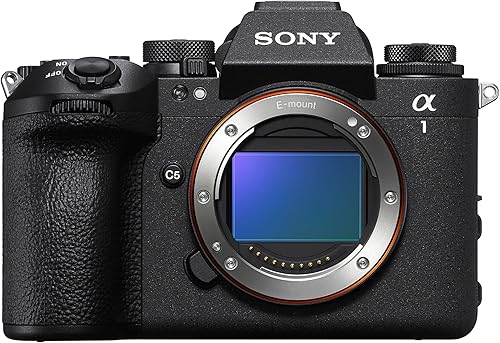
The Sony a1 II is the most versatile professional camera ever made, excelling equally at high-speed sports, landscape, portrait, wildlife, and video production. The 50.1MP stacked Exmor RS sensor delivers 30fps burst with full autofocus and auto-exposure tracking — an absurd combination of resolution and speed that no competitor matches. Sony’s AI-powered Real-time Recognition AF identifies and tracks humans, animals, birds, insects, cars, trains, and airplanes with startling accuracy even through dense foreground clutter. 8K 30fps video recording with full pixel readout, S-Cinetone color science, and 16-bit raw output position it as a serious cinema tool. The camera body weighs just 743g despite packed-in features, with a redesigned ergonomic grip improved from the original a1. Four-axis multi-angle LCD, dual CFexpress Type A card slots, and 10 Gbps USB-C tethering complete the professional toolkit. At ~$6,500, it costs a premium but genuinely does everything at the highest level.
✅ Pros
- 50.1MP at 30fps — unmatched speed + resolution combo
- AI-based subject detection for 8+ subject types
- 8K 30fps with full pixel readout
- Lightweight 743g body with improved ergonomics
- 16-bit raw video output for cinema production
- Backwards compatible with all Sony E-mount lenses
✖ Cons
- Highest price on this list at ~$6,500 body only
- 8K files demand fast cards and large storage
- Rolling shutter present in electronic shutter modes
- Menu system still complex despite improvements
- CFexpress Type A cards more expensive than Type B
Canon EOS R5 Mark II
Best All-Round Pro Camera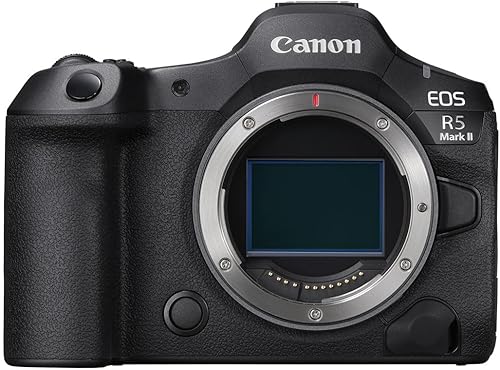
The Canon EOS R5 Mark II strikes the ideal balance between the flagship R1’s speed and the high-resolution specialist’s demands. The 45MP stacked CMOS sensor delivers 30fps electronic shutter burst with full AF tracking, making it fast enough for sports while resolving enough detail for landscape and commercial work. Canon’s Eye Control AF lets you select focus points by literally looking at your subject through the viewfinder — a technology Canon pioneered in the film era and has now perfected with AI-assisted gaze tracking. 8K raw internal recording, Canon Log 3, and improved heat management solve the overheating issues that plagued the original R5. The body retains the compact form factor professionals love for travel and documentary work. At approximately $4,300, it delivers 90% of the R1’s autofocus performance at roughly two-thirds the price, with significantly higher resolution. For working professionals who shoot everything from weddings to wildlife, the R5 II is the most well-rounded camera available.
✅ Pros
- Eye Control AF — select focus by looking at subject
- 45MP resolves detail for landscape and commercial
- 30fps burst speed matches most flagships
- 8K raw internal with improved heat management
- Compact body ideal for travel and documentary
- 90% of R1 AF performance at two-thirds the price
✖ Cons
- Still expensive at ~$4,300 body only
- Eye Control AF requires calibration per user
- Buffer clears slower with 45MP at 30fps
- Electronic shutter has visible rolling shutter
- No integrated vertical grip option
Nikon Z9
Best Sports & Action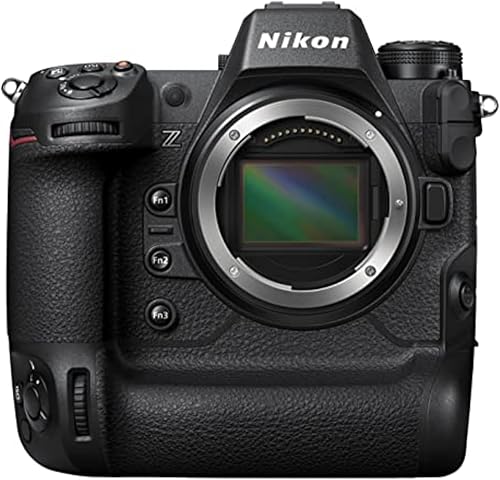
The Nikon Z9 rewrote the rules when it launched as the first professional mirrorless camera to completely eliminate the mechanical shutter, proving electronic-only could satisfy the most demanding professionals. The 45.7MP stacked CMOS sensor delivers 20fps raw burst (or 120fps at 11MP for peak action) with deep buffer depths that handle extended shooting bursts. Nikon’s 3D Tracking AF system, evolved from decades of DSLR expertise, latches onto subjects and follows them across the frame with tenacity that sports photographers trust implicitly. The integrated vertical grip provides NATO-strap mounting, dual CFexpress Type B slots, and 8K 30fps internal video recording. What makes the Z9 remarkable in 2026 is the price: at approximately $5,500, it has actually decreased since launch while receiving continuous firmware updates that have dramatically expanded its capabilities. Nikon’s commitment to free feature additions via firmware has made the Z9 more capable today than when reviewers originally tested it.
✅ Pros
- Continuous free firmware updates expand capabilities
- Integrated vertical grip with NATO-strap compatibility
- 3D Tracking AF is among the best for moving subjects
- 120fps burst for absolute peak-action moments
- Dual CFexpress Type B for maximum speed and redundancy
- Price has decreased while capabilities improved
✖ Cons
- Heavier than non-grip bodies (1.34 kg)
- 20fps raw burst slower than Canon R1 or Sony a1
- No option without integrated grip for lighter carry
- Base ISO 64 can require faster shutter speeds in bright light
- Z-mount lens ecosystem still smaller than Canon RF or Sony E
Nikon Z8
Best Value Flagship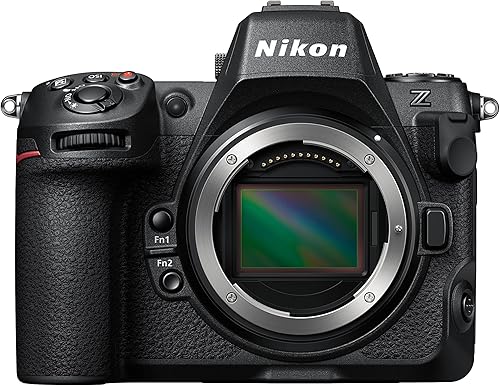
The Nikon Z8 is essentially a Nikon Z9 without the integrated vertical grip — the same 45.7MP stacked CMOS sensor, the same 3D Tracking AF system, the same 8K video capability, and the same continuous firmware updates in a body that weighs 25% less and costs roughly $1,500 less. This makes it the best value flagship camera on the market, delivering Z9-level performance at a price that competes with cameras a full tier below. The compact body attracts wedding photographers, travel journalists, and documentary shooters who need flagship AF and image quality without the bulk of an integrated grip. All Z9 firmware updates apply to the Z8, meaning it continues gaining features over time. Dual card slots (one CFexpress Type B, one SD UHS-II) provide flexible storage options, and the tilting touchscreen works equally well for stills and video. At approximately $4,000, it consistently ranks as the best value in the professional full-frame category.
✅ Pros
- Z9 sensor and AF in a 25% lighter body
- Best value flagship at ~$4,000
- All Z9 firmware updates apply to Z8
- Compact body ideal for travel and weddings
- Dual card slots with CFexpress + SD flexibility
- Strong community support and accessory ecosystem
✖ Cons
- No integrated vertical grip (optional accessory)
- SD card slot slower than dual CFexpress
- Single CFexpress slot limits redundancy for pros
- Buffer slightly smaller than Z9
- Viewfinder blackout slightly longer than Z9
Sony a9 III
Best Global Shutter
The Sony a9 III makes history as the world’s first full-frame camera with a global shutter sensor, completely eliminating rolling shutter distortion at any shutter speed. This means zero skewing of fast-moving subjects, zero banding under artificial lighting, and the ability to use flash at any shutter speed including 1/80,000s — capabilities no other camera at any price can match. The 24.6MP stacked sensor delivers 120fps burst shooting with full autofocus tracking, making it the fastest camera on this list by a wide margin. Sony’s AI-powered Real-time Recognition AF handles humans, animals, birds, insects, vehicles, and more. The global shutter does come with a trade-off: the 24.6MP resolution is lower than competitors, and high-ISO noise is slightly higher due to the global shutter sensor design. At approximately $6,000, it occupies a specialized niche for sports, automotive, and fashion photographers who demand absolute zero distortion and unlimited flash sync.
✅ Pros
- World’s first full-frame global shutter — zero rolling shutter
- 120fps burst with full AF tracking
- Flash sync at any shutter speed up to 1/80,000s
- Zero banding under artificial lighting
- AI subject recognition for 8+ categories
- Ideal for sports, fashion, and automotive photography
✖ Cons
- 24.6MP resolution lower than most competitors
- Higher base ISO (250) than standard sensors
- Global shutter slightly noisier at high ISO
- No 8K video recording capability
- Premium price for specialized use case
- Dynamic range slightly reduced vs traditional sensors
Hasselblad X2D II 100C
Best Medium Format
Hasselblad’s X2D II 100C represents the pinnacle of image quality with a massive 100MP medium format sensor that captures detail invisible to full-frame cameras. The 44x33mm sensor is 70% larger than full-frame, delivering shallower depth of field, wider dynamic range, and a distinctive three-dimensional rendering quality that medium format is famous for. The in-body image stabilization system provides up to 7 stops of compensation, making handheld medium format shooting practical for the first time. The 100MP resolution resolves detail that allows dramatic cropping while maintaining print-quality output, making it invaluable for landscape, architecture, fashion, and fine art photographers. Hasselblad’s Natural Colour Solution (NCS) color science produces skin tones and natural colors that require minimal post-processing. The beautifully machined Scandinavian design features a USBC-C port, dual SD card slots, and a gorgeous 3.6-inch OLED touchscreen. At approximately $8,200, it’s a specialized tool for photographers who prioritize image quality above all else.
✅ Pros
- 100MP medium format for unmatched image quality
- 70% larger sensor than full-frame
- 7-stop in-body image stabilization
- Natural Colour Solution for stunning skin tones
- Beautiful Scandinavian industrial design
- Wide dynamic range exceeds full-frame cameras
✖ Cons
- 3.3fps burst too slow for action
- Highest price on this list at ~$8,200
- AF system slower than full-frame flagships
- Limited XCD lens selection compared to Canon/Sony
- Video capabilities basic compared to competitors
- Heavy for extended handheld shooting
Fujifilm GFX 100 II
Best Resolution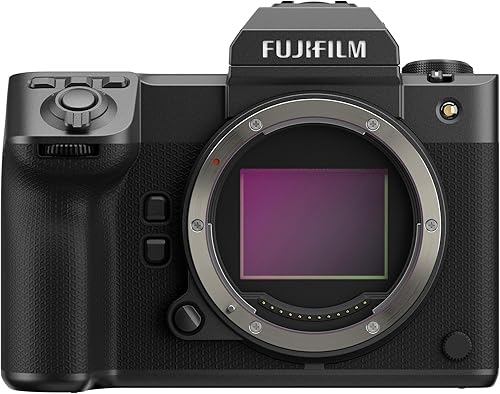
The Fujifilm GFX 100 II brings medium format image quality to a body that handles almost like a full-frame camera, bridging the gap between the Hasselblad’s image quality and the speed of full-frame flagships. The 102MP GFX sensor delivers stunning resolution with Fujifilm’s beloved film simulation modes (Velvia, Provia, Acros, Nostalgic Neg) baked into the processing pipeline. At 8fps burst shooting, it’s the fastest medium format camera ever made, opening medium format to event, editorial, and even moderate-speed sports photography for the first time. The AI-powered subject detection AF system tracks humans, animals, and vehicles with accuracy that rivals full-frame systems. Internal 8K 30fps video recording and Apple ProRes support make it a viable cinema tool. IBIS provides up to 8 stops of stabilization. At approximately $7,500, it undercuts the Hasselblad while offering significantly better speed, video, and AF performance, making it the most practical medium format camera for working professionals.
✅ Pros
- Fastest medium format camera at 8fps
- 102MP with Fujifilm film simulation modes
- 8K internal video with Apple ProRes support
- 8-stop IBIS for handheld medium format
- AI subject detection AF rivals full-frame
- More practical than Hasselblad for working pros
✖ Cons
- Still slower than full-frame flagships for sports
- Large and heavy compared to full-frame bodies
- GF lens lineup smaller than full-frame systems
- Base ISO 80 limits low-light flexibility
- Expensive at ~$7,500 body only
- Rolling shutter visible in electronic shutter mode
Leica SL3
Best Build Quality
The Leica SL3 is for the photographer who demands an uncompromising shooting experience with the finest build quality in the industry. Machined from a single block of aluminum with a dust and splash-resistant body, the SL3 feels like a precision instrument in a way that mass-produced cameras simply cannot match. The 60MP full-frame sensor delivers exceptional resolution with Leica’s signature rendering — a subtle, three-dimensional quality in the way it separates subjects from backgrounds that photographers describe as the “Leica look.” Maestro IV image processing produces clean, artifact-free files with natural color reproduction. The 5.76-million-dot OLED electronic viewfinder is among the best ever fitted to a camera, and the minimalist control layout forces a deliberate, thoughtful shooting style. The L-Mount Alliance means access to lenses from Leica, Sigma, and Panasonic. At approximately $6,400, you’re paying for decades of optical heritage, hand-assembled German engineering, and an experience that transcends specifications.
✅ Pros
- Finest build quality of any camera on this list
- 60MP resolution ideal for detail-oriented work
- Signature Leica rendering and color science
- 5.76M-dot OLED EVF is industry-leading
- L-Mount Alliance opens Sigma and Panasonic lenses
- Minimalist controls encourage deliberate shooting
✖ Cons
- AF system slower than Canon/Sony/Nikon flagships
- 15fps burst slower than stacked-sensor competitors
- Video features lag behind Sony and Canon
- Limited Leica lens selection at lower price points
- ~$6,400 pays a brand premium over competitors
- Fewer customizable buttons than Japanese cameras
Canon EOS R3
Best Pro Workhorse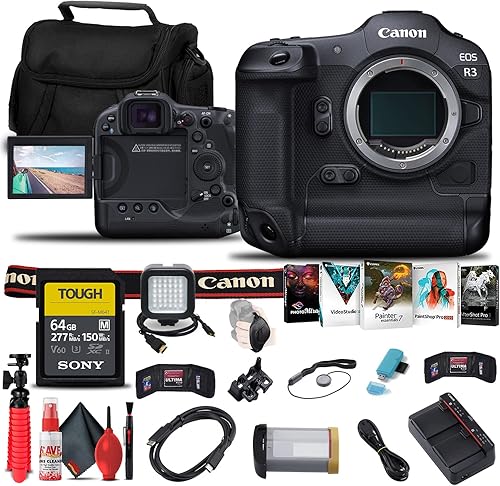
The Canon EOS R3 occupies a unique position as a professional workhorse that sits between the extreme speed of the R1 and the resolution of the R5 Mark II at a now-reduced price point. The 24.1MP stacked CMOS sensor delivers 30fps electronic shutter burst with Eye Control AF — the same gaze-tracking technology later refined for the R5 II. For sports and event photographers who need reliable performance without the R1’s flagship price, the R3 remains an excellent choice in 2026. The integrated vertical grip provides all-day comfort with dual CFexpress card slots, and the weather sealing matches the R1’s professional standard. 6K raw internal video, Canon Log 3, and 4K 120fps slow motion cover professional video needs. Since the R1’s release, the R3’s price has dropped to approximately $4,500 — making it genuinely compelling as a professional body with proven reliability and years of real-world testing. Many working photographers continue to prefer it over newer models for its proven track record and accumulated firmware maturity.
✅ Pros
- Proven reliability with years of professional use
- Eye Control AF for intuitive focus point selection
- 30fps burst matches newer flagships
- Integrated grip for all-day shooting comfort
- Price reduced since R1 release
- Mature firmware with known, stable behavior
✖ Cons
- 24.1MP resolution limits cropping flexibility
- Superseded by R1 for absolute top-tier speed
- Eye Control requires per-user calibration
- Heavier than non-grip alternatives
- No 8K video like newer competitors
- Stacked sensor still shows minor rolling shutter
How We Ranked the Best Professional Cameras of 2026
Every ranking on TheShoposaurus starts with extensive research: we evaluate dozens of expert reviews and lab tests, verify manufacturer specifications against official sources, and weigh thousands of verified owner experiences to find the best professional cameras for real-world use. Products are scored on image quality, autofocus, build and reliability, lens ecosystem, and value.
- Best professional cameras — Best Pro Camera Overall: Canon EOS R1
- Best professional cameras — Best Hybrid Pro Camera: Sony a1 II
- Best professional cameras — Best All-Round Pro Camera: Canon EOS R5 Mark II
- Best professional cameras — Best Sports & Action: Nikon Z9
- Best professional cameras — Best Value Flagship: Nikon Z8
What is the best professional camera in 2026?
The best professional cameras pair top-tier image quality with fast, dependable autofocus, weather-sealed durable bodies, dual card slots, and a deep lens ecosystem. Full-frame flagship mirrorless models from Sony, Canon, and Nikon lead the field, chosen by working photographers for their speed, reliability, and low-light performance.
DSLR vs mirrorless for professionals — which is better?
Mirrorless has become the professional standard. It delivers faster and smarter autofocus, silent shooting, higher burst rates, and better video, and it is where all new flagship development happens. Some pros still keep DSLRs for their optical viewfinders and battery life, but for reliability, speed, and future lens support, mirrorless is the professional choice in 2026.
Full frame vs crop sensor for professional work — which do you need?
Most professionals choose full-frame for its superior low-light performance, dynamic range, and shallow depth of field, which matter for weddings, portraits, and commercial work. Crop-sensor bodies still have a place for sports and wildlife pros who value the extra reach and lighter kit. Match the sensor to your genre rather than assuming full-frame is always required.
What makes a camera professional?
A professional camera is defined less by megapixels than by reliability and workflow: weather sealing, a shutter rated for high cycle counts, dual card slots for backup, fast and consistent autofocus, robust battery life, and support like fast tethering and pro service programs. These are the features that let a working shooter trust the camera on a paid job.
How much do professional cameras cost?
Professional camera bodies typically run $2,000–$6,500, with flagship sports and studio models reaching higher. Lenses often cost as much as the body — a working kit of pro glass can add $3,000–$8,000 — so budget for lenses, backups, and accessories, which matter as much as the camera to consistent professional results.