Best Hybrid Photo-Video Cameras
March 2026
Autofocus precision, video capability, image quality, stabilization, and real-world value — scored across the best mirrorless cameras that excel at both photography and filmmaking.
⚔️ Head to Head Battle
Canon EOS R6 Mark III
Best Overall Hybrid Camera
Expert reviewers consistently agree: the Canon EOS R6 Mark III is the new benchmark for hybrid cameras. Its 32.5MP sensor resolves noticeably more detail than the 24MP competitors from Nikon and Panasonic, while internal 7K 60p RAW recording and open gate capture at up to 7K 30p give filmmakers flexibility that previously required dedicated cinema cameras. The Dual Pixel CMOS AF II system is consistently rated the best autofocus in the hybrid class — tracking subjects through complex scenes with class-leading reliability. The 40fps burst with 20 frames of pre-capture ensures you never miss the decisive moment in sports or wildlife. Canon Log 2 delivers 15+ stops of dynamic range for video, while 8.5-stop IBIS keeps handheld shots steady. The dual card slots (CFexpress Type B + SD UHS-II) provide professional workflow flexibility. At $2,900, it’s priced identically to the Sony A7 V but offers superior video specs and resolution.
✅ PROS
- 7K 60p RAW internal — best video specs in class
- 32.5MP — highest resolution mid-range hybrid
- Class-leading Dual Pixel CMOS AF II tracking
- 40fps burst with 20-frame pre-capture
- 8.5-stop IBIS — strongest stabilization here
- Canon Log 2 with 15+ stops dynamic range
✖ CONS
- RF mount lens ecosystem more limited than Sony E
- 7K RAW has recording time limits
- $2,900 body only — premium pricing
- No mechanical shutter
- Battery life below Sony A7 V
- CFexpress cards expensive vs SD
Sony A7 V
Best Tracking Autofocus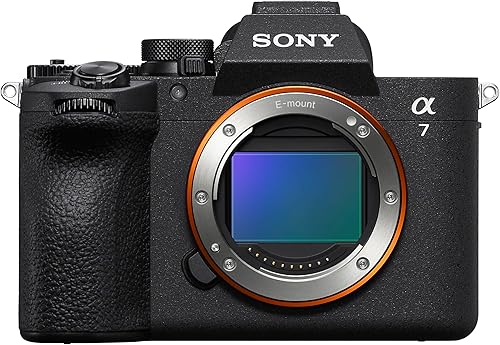
Sony’s A7 V arrives with the AI Processing Unit from the flagship A1 II, delivering what is widely regarded as the most advanced subject tracking autofocus available in a mid-range body. Human pose estimation analyzes body, head, and eye positions simultaneously — maintaining focus even when subjects are partially obscured or crossing paths. The 33MP partially stacked Exmor RS sensor provides 4.5x faster readout than its predecessor, enabling truly blackout-free 30fps bursts and dramatically reduced rolling shutter. The massive Sony E-mount ecosystem — the largest mirrorless lens library in the world — gives shooters access to hundreds of native and third-party lenses at every price point. At 4K 120p video (1.5x crop) and 7.5-stop IBIS, it matches most competitors on stabilization while exceeding them on autofocus intelligence. The 16-stop dynamic range at base ISO makes it the DR leader in this class. The tradeoff: video specs trail the Canon R6 III, with no internal RAW recording and 4K/120p requiring a crop.
✅ PROS
- AI tracking AF — best subject detection available
- Largest lens ecosystem (E-mount)
- 30fps truly blackout-free shooting
- 16 stops dynamic range — class leader
- 14-bit RAW electronic shutter
- 33MP partially stacked sensor — fast readout
✖ CONS
- 4K 120p has 1.5x crop
- No internal RAW video recording
- $2,900 — same price as Canon R6 III with less video
- CFexpress Type A cards are expensive and slow
- Video specs trail Canon R6 III overall
- Ergonomics divisive — grip comfort varies
Nikon Z8
Best Flagship Value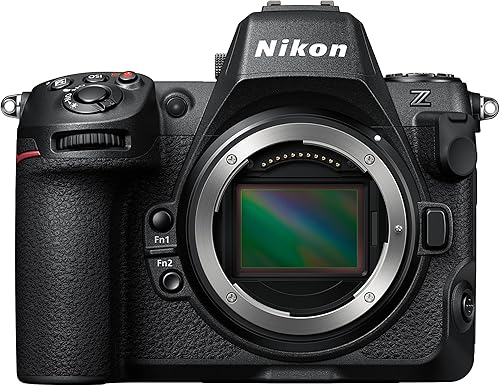
The Nikon Z8 packs the same 45.7MP stacked CMOS sensor and EXPEED 7 processor as the $5,500 Z9 flagship into a smaller, lighter body at $3,500 — making it arguably the best value flagship camera ever released. Its video specifications are widely rated as unmatched by any hybrid camera on the market: internal 8K 60p in 12-bit N-RAW, 4K 120p, and ProRes RAW HQ without needing an external recorder. The 120fps burst shooting with full AF/AE tracking and pre-release capture gives sports and wildlife photographers capabilities that rival dedicated action cameras. Nikon’s deep learning AF algorithm detects nine subject types (people, dogs, cats, birds, cars, bikes, motorcycles, trains, planes) and combines subject detection with 3D tracking for the most persistent focus lock in complex scenes. The all-electronic shutter reaches 1/32000 sec with virtually no rolling shutter distortion. At 45.7MP, it delivers the highest resolution on this list while maintaining burst speeds that put 24MP cameras to shame.
✅ PROS
- 45.7MP — highest resolution on this list
- 8K 60p N-RAW + ProRes RAW internal
- 120fps burst — fastest on this list
- Z9 flagship tech at $2,000 less
- 9-subject deep learning AF detection
- Virtually zero rolling shutter distortion
✖ CONS
- $3,500 — most expensive mid-tier here
- Heavy at 910g body only
- No mechanical shutter
- Nikon Z lens ecosystem smaller than Sony E
- CFexpress B required for 8K/RAW
- Battery life lower than Z9
Nikon Z6 III
Best Value Full-Frame Hybrid
At $400 less than the Canon R6 III and Sony A7 V, the Nikon Z6 III delivers 90% of their capability at a meaningfully lower price — which is why it consistently ranks among the most-recommended hybrid cameras. The partially stacked 24.5MP sensor operates 3.5x faster than its predecessor, enabling 6K 60p internal RAW recording and 4K 120p video that rivals cameras costing $1,000 more. It ranks as one of the best value full-frame cameras available, and multiple photography community discussions confirm it holds its own against the Canon and Sony flagships for most real-world shooting. The EXPEED 7 processor brings the same deep learning AF from the Z8/Z9, and the build quality — including a top LCD, weather sealing, and dual card slots — feels premium. The 8-stop IBIS is among the best in class, and Nikon’s color science consistently receives praise from portrait and wedding photographers. Where it trails: 24.5MP is lower resolution than competitors, and it lacks RAW pre-capture.
✅ PROS
- $2,500 — $400 cheaper than Canon/Sony rivals
- 6K 60p internal RAW — excellent video value
- 8-stop IBIS — among best in class
- Same EXPEED 7 AF as Z8/Z9 flagships
- Top LCD panel — premium ergonomics
- Nikon color science praised for portraits
✖ CONS
- 24.5MP — lowest resolution full-frame here
- No RAW pre-capture (JPEG only)
- Nikon Z lens ecosystem still growing
- microSD second slot limits pro workflow
- Rolling shutter worse than stacked sensors
- Battery life shorter than A7 V
Fujifilm X-H2S
Best APS-C Hybrid Camera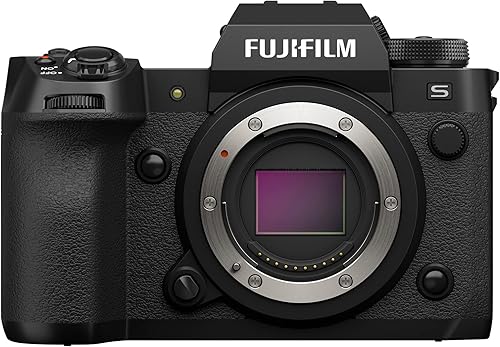
Fujifilm’s X-H2S proves that APS-C sensors can compete with full-frame in video quality. Its stacked BSI sensor virtually eliminates rolling shutter — a feat that reviewers consistently highlight as remarkable for any sensor size. Internal 6.2K 30p open-gate recording and 4K 120p with minimal artifacts give filmmakers the flexibility to crop and reframe in post-production. The internal ProRes 422 HQ codec and F-Log2 gamma curve (14-bit selectable) deliver a color depth and dynamic range that approaches full-frame quality. The rugged, weather-sealed magnesium alloy body with a deep grip feels like a professional cinema tool rather than a consumer camera. Fujifilm’s legendary Film Simulations — including Eterna and Classic Neg — produce stunning colors straight out of camera, reducing post-processing time. At $2,500, it costs the same as the Nikon Z6 III but in a smaller, lighter package with the 1.5x crop factor advantage for wildlife and sports telephoto reach.
✅ PROS
- Stacked sensor — virtually zero rolling shutter
- Internal ProRes 422 HQ recording
- 6.2K open-gate for flexible cropping
- Film Simulations — stunning out-of-camera color
- Rugged weather-sealed magnesium body
- 1.5x crop advantage for wildlife telephoto
✖ CONS
- APS-C sensor — smaller than full-frame rivals
- $2,500 — expensive for APS-C
- 26.1MP effective with crop factor
- Fujifilm X lens ecosystem smaller than Sony E
- Battery life moderate — ~580 shots
- No full-frame option in X-mount system
Sony A7 IV
Best Budget Full-Frame Hybrid
The Sony A7 IV has been the best-selling full-frame hybrid camera since its 2021 launch, and at its current $1,800 street price, it remains the smartest entry point into full-frame hybrid shooting. It delivers excellent value with overall video and image quality that punches well above its current price. The 33MP Exmor R sensor and BIONZ XR processor deliver the same resolution as the newer A7 V in a body that costs $1,100 less. Real-time eye AF and subject tracking — while not AI-powered like the A7 V — remain reliable for portraits, events, and casual wildlife. The massive Sony E-mount lens library means you can build a complete system with affordable third-party lenses from Sigma, Tamron, and Viltrox. 4K 60p video is available with a 1.5x crop, and 10-bit 4:2:2 internal recording handles color grading well. The tradeoffs versus newer cameras: higher rolling shutter, no pre-capture, slower burst speeds, and an older rear screen. But at $1,800, none of that matters for the majority of shooters.
✅ PROS
- $1,800 — best value full-frame on this list
- 33MP sensor — same resolution as A7 V
- Massive Sony E-mount lens ecosystem
- 10-bit 4:2:2 internal recording
- Proven reliability — years of firmware updates
- Real-Time Eye AF still excellent for portraits
✖ CONS
- Higher rolling shutter than newer cameras
- 4K 60p requires 1.5x crop
- No pre-capture or AI tracking
- 5.5-stop IBIS — weakest full-frame here
- 10fps burst — slowest on this list
- Older rear screen design
Panasonic Lumix S5 IIX
Best Video-First Hybrid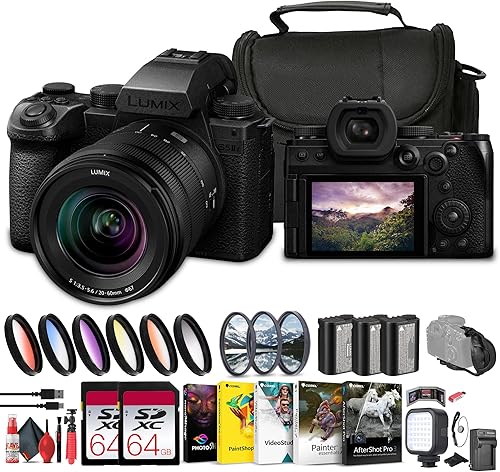
If video is your primary focus but you still need capable stills, the Panasonic S5 IIX is the strongest video-first hybrid under $2,500. It records 5.8K ProRes internally, outputs RAW over HDMI, and supports IP streaming — capabilities that no other camera at this price matches. Panasonic’s legendary color science delivers rich, cinematic skin tones straight from the sensor, and the unlimited 4K 60p recording (no overheating cutoff) makes it the only camera on this list you can trust for all-day event videography. The Phase Hybrid AF — Panasonic’s first phase-detection system — corrected the brand’s historical AF weakness, and while it doesn’t match Sony or Canon for tracking speed, it’s reliable for most shooting scenarios. The L-Mount Alliance gives access to Panasonic, Leica, and Sigma lenses, with several excellent affordable Sigma primes. At $2,000, it undercuts every full-frame competitor on this list while offering ProRes recording that typically costs $4,000+ in other systems.
✅ PROS
- Internal ProRes recording — rare under $2,500
- Unlimited 4K 60p — no overheating cutoff
- 5.8K 30p + RAW over HDMI
- Panasonic color science — best skin tones
- $2,000 — cheapest full-frame with ProRes
- IP streaming built-in for live production
✖ CONS
- Phase Hybrid AF trails Sony and Canon
- 24.2MP — lower resolution for stills
- L-Mount lens ecosystem smaller than E/RF
- 5-stop IBIS — weakest full-frame here
- No 8K recording capability
- Rolling shutter higher than stacked sensors
Fujifilm X-T5
Best Photography-First Hybrid
The Fujifilm X-T5 is the camera for photographers who also shoot video — not the other way around. Its 40.2MP X-Trans CMOS 5 HR sensor is the highest resolution APS-C sensor ever made, delivering detail that rivals 60MP full-frame cameras when pixel-peeping at normal viewing distances. The retro dial-based interface — with dedicated physical controls for ISO, shutter speed, and exposure compensation — makes it the most tactile, enjoyable camera to shoot with on this list. Photographers consistently praise it as a camera that makes photography fun again. Fujifilm’s Film Simulations (including Nostalgic Neg and Classic Chrome) produce colors that photographers love straight out of camera, reducing editing time dramatically. Video is capable at 6.2K 30p in 10-bit 4:2:2 with F-Log2, but it’s clearly a secondary function — no ProRes internal, and the tilting (not articulating) screen favors stills composition. At $1,700, it’s the most affordable camera on this list that delivers genuine professional image quality.
✅ PROS
- 40.2MP — highest resolution APS-C ever
- $1,700 — most affordable pro-quality camera here
- Film Simulations — stunning out-of-camera JPEGs
- Retro dial controls — most enjoyable to shoot
- 7-stop IBIS in a compact 557g body
- Pixel Shift mode for 160MP composites
✖ CONS
- APS-C sensor — smaller than full-frame rivals
- Tilting screen — not fully articulating for video
- 6.2K video has recording time limits
- No internal ProRes recording
- AF trails Canon/Sony for fast action
- 20fps burst — moderate vs competitors
Canon EOS R5 Mark II
Best High-Resolution Hybrid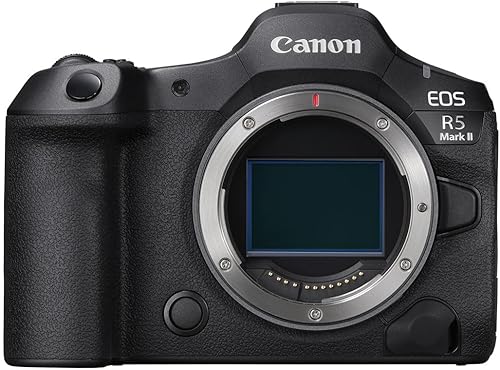
The Canon EOS R5 Mark II represents the absolute pinnacle of hybrid camera technology in 2026 — a 45MP stacked CMOS sensor with internal 8K 60p RAW recording, 30fps bursts, and the same class-leading Dual Pixel CMOS AF II from the R6 III. It earns top recommendations for photographers who need maximum resolution alongside professional video. The stacked sensor design virtually eliminates rolling shutter while maintaining 45MP resolution, and Canon’s new DIGIC X processor handles the massive data throughput without overheating (with the optional fan grip). Eye Control AF — letting you select focus points by looking at them through the viewfinder — is a genuine innovation that no competitor offers. At $4,300, it’s the most expensive camera on this list by a significant margin, which is why it ranks #9 despite its superior specs: for most hybrid shooters, the R6 III delivers 90% of the R5 II’s capability at 67% of the price. But for professionals who need both 45MP stills and 8K video in a single body, nothing else compares.
✅ PROS
- 45MP stacked sensor — elite resolution + speed
- 8K 60p RAW internal recording
- Eye Control AF — industry first
- 8.5-stop IBIS — strongest stabilization
- Same AF system as R6 III — class-leading
- Canon Log 2 with 15+ stops DR
✖ CONS
- $4,300 — most expensive on this list
- Fan grip recommended for extended 8K recording
- RF mount lens ecosystem more limited
- Massive file sizes — storage intensive
- R6 III offers 90% capability at 67% price
- Overkill for most hybrid shooters
Panasonic Lumix S1 II
Best IBIS & Low-Light Hybrid
The Panasonic S1 II arrives as the most capable Lumix hybrid ever, featuring a partially stacked 24.1MP sensor — a first for the S Series — that enables 5.1K 60p open gate recording and 70fps AFC burst shooting. Reviewers call it one of the finest high-end still/video hybrids around — a dependable workhorse that delivers every single time. Dynamic Range Boost — another Lumix first — provides 15 stops of dynamic range with smoother gradations than any previous Panasonic camera. The 8-stop 5-axis IBIS with Active I.S. produces remarkably stable handheld footage, even while walking. Panasonic’s color science remains the gold standard for skin tones in video, and REAL TIME LUT support lets you preview custom looks while shooting. Internal ProRes RAW HQ and 4K 120p give professional videographers the tools they need. At $2,500, it competes directly with the Nikon Z6 III but trades resolution for superior video color science and stabilization.
✅ PROS
- 8-stop IBIS + Active I.S. — steadiest handheld
- Dynamic Range Boost — 15 stops in video
- 70fps AFC burst — fastest Lumix ever
- Internal ProRes RAW HQ recording
- Panasonic color science — best skin tones
- 5.1K 60p open gate for flexible framing
✖ CONS
- 24.1MP — lower resolution than competitors
- L-Mount lens ecosystem still growing
- Phase Hybrid AF trails Sony and Canon
- $2,500 — same price as Nikon Z6 III
- Larger and heavier body than rivals
- New model — limited long-term track record
How We Ranked the Best Hybrid Cameras of 2026
Every ranking on TheShoposaurus starts with extensive research: we evaluate dozens of expert reviews and lab tests, verify manufacturer specifications against official sources, and weigh thousands of verified owner experiences to find the best hybrid cameras for real-world use. Products are scored on photo and video quality, autofocus, overheating limits, stabilization, and value.
- Best hybrid cameras — Best Overall Hybrid Camera: Canon EOS R6 Mark III
- Best hybrid cameras — Best Tracking Autofocus: Sony A7 V
- Best hybrid cameras — Best Flagship Value: Nikon Z8
- Best hybrid cameras — Best Value Full-Frame Hybrid: Nikon Z6 III
- Best hybrid cameras — Best APS-C Hybrid Camera: Fujifilm X-H2S
What is a hybrid camera?
A hybrid camera is one designed to shoot both high-quality stills and professional video equally well, rather than favoring one over the other. Hybrids pair strong photo features like fast autofocus and high resolution with serious video specs such as 4K/6K recording, high frame rates, and good heat management, making them ideal for creators who do both.
What is the best hybrid camera in 2026?
The best hybrid cameras deliver excellent photo quality and pro-grade video in one body, with reliable autofocus that works in both modes and enough cooling to record long clips. Full-frame hybrids lead for image quality and low light, while APS-C hybrids offer most of the capability in a smaller, more affordable package popular with content creators.
What makes a good hybrid (photo and video) camera?
A good hybrid combines high-resolution stills, fast and sticky autofocus with eye-tracking, 4K or higher video at 60fps, useful slow-motion modes, in-body stabilization, and enough thermal headroom to avoid overheating on long takes. Microphone and headphone ports and a fully articulating screen round out a camera that works for both photographers and videographers.
Are hybrid cameras good for both photos and video?
Yes — that is exactly what they are built for. A modern hybrid takes stills that rival dedicated photo cameras and shoots video that rivals dedicated video cameras, switching between the two instantly. A pure photo or cinema camera may edge it in one narrow area, but for the vast majority of creators a hybrid is the most versatile single camera to own.
Do you need a full-frame hybrid camera?
Not necessarily. Full-frame hybrids give the best low-light performance and shallowest depth of field, which matters for professional work, but excellent APS-C hybrids deliver superb photos and 4K video for content creation at a lower price and smaller size. Choose full-frame for demanding low-light or client work; otherwise an APS-C hybrid is the smarter value.