Best Cameras for Beginners
January 2026
Every entry-level camera scored on what new photographers actually need — guided shooting modes, autofocus reliability, image quality in auto, weight, and a clear upgrade path that grows with you. From $679 starter kits to $1,200 advanced-beginner bodies.
⚔️ Head to Head Battle
Canon EOS R50
Best First Camera
Canon designed the R50 for beginners, and it shows. The guided UI mode walks through every setting with plain-language explanations, so first-time users never feel lost in technical jargon. The 24.2MP APS-C sensor produces sharp, vibrant images in full auto mode that consistently outperform smartphone cameras, especially in challenging light. The vari-angle flip screen makes selfies and vlogging effortless, while Canon’s proven Dual Pixel AF system tracks faces and animals with impressive accuracy. At ~$679 with the 18-45mm kit lens, it offers the best balance of ease-of-use and image quality for anyone stepping up from a phone. The RF-S lens mount gives beginners a clear upgrade path as their skills grow, with affordable prime and zoom options available.
✅ PROS
- Guided UI explains settings in plain English
- Dual Pixel AF tracks faces reliably
- Flip screen for selfies and vlogging
- 375g is very lightweight
- RF-S lens path for upgrading
✖ CONS
- Kit lens (18-45mm) is basic
- No IBIS — lens stabilization only
- 4K 30fps with significant crop
- EVF is small
- Battery life ~310 shots
Nikon Z50 II
Best Nikon Starter
Nikon’s Z50 II brings flagship-level Expeed 7 processing and AI subject-detection AF down to a beginner-friendly price of ~$759 with kit lens. The 20.9MP sensor captures sharp, well-exposed images in auto mode with Nikon’s signature color rendition that photographers have trusted for decades. The i-Menu system presents complex settings in an approachable way, and 31 built-in Picture Control presets let beginners instantly experiment with different color styles and moods without any editing software. The retro-inspired design with a deep grip makes it one of the most comfortable small cameras to hold, and the control layout mirrors Nikon’s professional Z-mount cameras — so when you’re ready to upgrade to full-frame, the transition feels natural and seamless.
✅ PROS
- Expeed 7 processing in a beginner body
- Subject-detection AF tracks 9 types
- i-Menu simplifies settings
- Satisfying retro-inspired design
- Great upgrade path to Z-mount full-frame
✖ CONS
- 20.9MP is lower resolution
- Flip-down screen not ideal for vlogging
- Z DX lens selection still growing
- No IBIS
- Battery life ~330 shots
Sony a6700
Best Enthusiast Starter
The a6700 is the camera for beginners who already know they’re serious about photography. The 26MP APS-C sensor paired with Sony’s AI-based 759-point autofocus system delivers professional-grade results that rival cameras costing twice as much. With 4K 120fps video recording in 10-bit color, it handles everything from cinematic slow-motion to fast-paced action with ease. Sony’s massive E-mount lens ecosystem — the largest of any mirrorless system — means you’ll never run out of glass to grow into. The 5-axis in-body image stabilization keeps handheld shots steady even in low light. At ~$1,398 for the body, it’s a significant investment for a first camera, but a buy-it-once solution you won’t outgrow for five or more years.
✅ PROS
- Camera you won’t outgrow for 5+ years
- AI-based AF is pro-level
- 4K 120fps video is exceptional
- Massive E-mount lens ecosystem
- 5-axis IBIS included
✖ CONS
- ~$1,398 body is steep for a first camera
- Complex menus can overwhelm beginners
- No guided/beginner mode
- 493g is heavier than competitors
- Kit lens is average
Fujifilm X-S20
Best for Learning Photography
Fujifilm’s X-S20 takes a unique approach to teaching photography: its 19 Film Simulation modes let beginners create stunning images by choosing a visual mood rather than adjusting technical settings. Select Classic Chrome for street photography, Velvia for vivid landscapes, or Eterna for cinematic video — and the camera handles the rest. The 26.1MP X-Trans sensor paired with the X-Processor 5 delivers Fujifilm’s acclaimed color science, producing images that look magazine-ready straight out of camera with minimal editing. The deep handgrip and 5-axis IBIS provide steady handheld shooting, and 6.2K video at 30fps in 10-bit color gives serious video capability. Battery life has been dramatically improved over its predecessor, lasting up to 750 shots per charge.
✅ PROS
- Film simulations teach visual storytelling
- Gorgeous out-of-camera colors
- 6.2K video is excellent
- Intuitive and approachable interface
- Large battery — 750 shots
✖ CONS
- ~$1,299 is mid-range pricing
- 8fps burst is slower than rivals
- XF lens prices add up quickly
- AF tracking lags behind Canon/Sony
- No weather sealing
Canon EOS R100
Most Affordable Mirrorless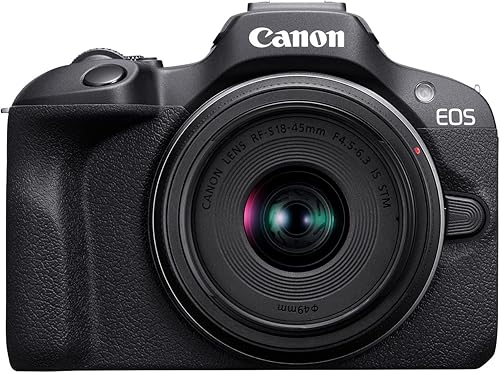
Canon stripped mirrorless photography to its essentials with the R100, creating the most affordable entry point into Canon’s RF lens ecosystem at just ~$479 with kit lens. The 24.1MP APS-C sensor and Dual Pixel AF system deliver the same core image quality that makes Canon the world’s most popular camera brand. The guided UI mode explains settings in plain language for complete beginners, and Creative Assist lets you adjust background blur, brightness, and color with simple sliders. At just 356 grams, it’s lighter than most smartphones with a case. The tradeoffs are real — no flip screen, no touchscreen, and heavily cropped 4K video — but for budget-conscious beginners who primarily want great stills and plan to upgrade later, nothing else comes close at this price point.
✅ PROS
- ~$479 for Canon mirrorless is remarkable
- Dual Pixel AF works well
- 356g is extremely lightweight
- Guided UI for beginners
- RF-S lens upgrade path
✖ CONS
- No flip screen
- No touchscreen
- Fixed LCD limits angles
- 4K heavily cropped
- 6.5fps burst is slow
Nikon Z30
Best Beginner Vlog Camera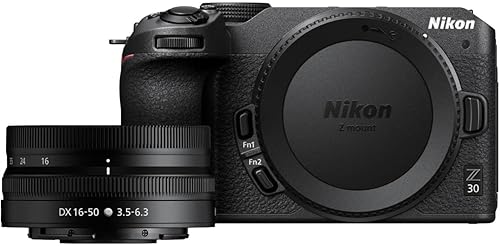
Nikon built the Z30 from the ground up for first-time vloggers and content creators. By eliminating the electronic viewfinder, Nikon kept the price accessible at ~$706 with kit lens while investing in what vloggers actually need: a large flip-out touchscreen for selfie framing, a dedicated red video record button on top of the body, and a 3.5mm external microphone input for audio upgrades. The 20.9MP sensor handles 4K 30fps video with reliable face-tracking AF that keeps you in focus as you move. The compact 350-gram body is easy to carry all day, and Nikon’s Z DX lens mount provides an upgrade path to the excellent Z50 II or even full-frame Z-mount bodies when you’re ready. For creators who prioritize video over stills, it’s the most focused beginner option available.
✅ PROS
- Designed specifically for vlogging beginners
- Flip-out screen for selfie framing
- 350g is very light
- External mic input for audio
- ~$706 is accessible pricing
✖ CONS
- No viewfinder at all
- 20.9MP is modest resolution
- 4K cropped significantly
- No IBIS
- Z DX lens selection limited
Panasonic Lumix G100D
Best Budget Vlog Kit
Panasonic designed the G100D as a complete content creation kit in a single box. The camera ships with both a 12-32mm kit lens and a tripod grip that doubles as a wireless remote control — everything you need to start vlogging immediately. The standout feature is OZO spatial audio technology, which uses the camera’s built-in microphones to capture directional sound that automatically prioritizes audio from in front of the camera. The 20.3MP Micro Four Thirds sensor is smaller than APS-C alternatives, but Panasonic compensates with excellent video processing and V-Log L capability for advanced color grading. At ~$747 for the complete kit, no other camera gives beginners this much out-of-the-box readiness without requiring separate purchases of grips, remotes, or audio equipment.
✅ PROS
- Complete kit: camera + lens + tripod grip
- OZO spatial audio from built-in mics
- 345g is lightweight
- Everything you need in one box
- V-Log L for color grading
✖ CONS
- MFT sensor smaller than APS-C
- Contrast AF only — hunts in low light
- 4K cropped
- MFT system is shrinking
- No viewfinder
OM System E-M10 Mark IV
Best Compact Beginner
The E-M10 Mark IV proves that great cameras don’t need to be big. Built on the Micro Four Thirds system, it pairs a compact 383-gram body with genuinely tiny lenses that make the entire kit pocketable in a way no APS-C system can match. The 20MP sensor is paired with 4.5-stop in-body image stabilization — a feature usually reserved for much more expensive cameras — which dramatically reduces blur in handheld shots and makes a real difference for beginners still developing steady shooting technique. The 15fps electronic burst mode catches fast action that other entry-level cameras miss entirely. For travel photographers counting every gram in their bag, or anyone who wants a real camera they’ll actually carry every day because it’s so small, the E-M10 IV earns its place.
✅ PROS
- Most compact ILC system available
- 4.5-stop IBIS valuable for beginners
- 15fps burst catches action
- Tiny MFT lenses save space
- ~$699 with kit lens is fair
✖ CONS
- MFT sensor limits low-light
- Contrast AF only
- Flip-down screen not ideal for selfies
- MFT system declining
- Menu system is complex
Sony ZV-E10 II
Best Content Creator Starter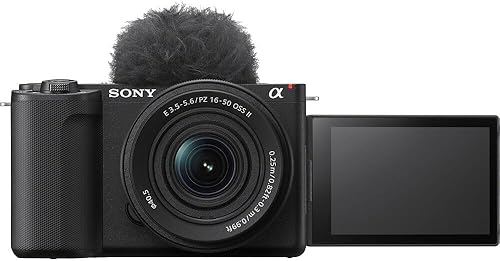
Sony designed the ZV-E10 II as the ideal camera for social media creators who want to look professional without learning professional camera settings. The Background Defocus button instantly blurs backgrounds with a single press — no aperture knowledge required. Product Showcase mode automatically shifts focus to items held up to the camera, perfect for unboxing videos and product reviews. The 26MP APS-C sensor delivers images and video that look polished on Instagram, YouTube, and TikTok. Sony’s E-mount compatibility is the real long-term advantage: it’s the same lens mount used by Sony’s professional cameras, giving creators access to hundreds of lenses as their channel grows. The compact 377-gram body keeps things light for handheld shooting and travel.
✅ PROS
- Background Defocus button is genius
- Product Showcase mode for creators
- 26MP sensor matches pro a6700
- E-mount ecosystem to grow into
- Compact 377g body
✖ CONS
- No viewfinder
- No IBIS — digital stabilization only
- Menus can overwhelm beginners
- ~$998 is mid-range
- Battery life is modest
Panasonic Lumix ZS99
Best Travel Zoom
The ZS99 takes a fundamentally different approach to beginner photography: instead of interchangeable lenses, it packs a 30x optical zoom covering 24-720mm equivalent into a body that genuinely fits in a jacket pocket. For beginners who want one camera that handles everything — wide-angle landscapes, group selfies, distant wildlife, concert stages — without ever changing a lens, this is the Swiss Army knife. The 1/2.3-inch sensor is smaller than mirrorless cameras on this list, but it still produces images noticeably better than smartphones, especially at zoom distances where phones fall apart. 4K video recording captures vacation memories in sharp detail. At ~$498, it removes every barrier to entry: no lens decisions, no bulk, and no budget anxiety.
✅ PROS
- 24-720mm zoom in a pocketable body
- No lens changes needed — all-in-one
- 30x zoom covers wide to super-tele
- 4K video for vacation footage
- ~$498 is very affordable
✖ CONS
- 1/2.3″ sensor is small
- Image quality drops at tele end
- No viewfinder
- Slow max aperture at zoom
- Sensor much smaller than mirrorless
How We Ranked the Best Beginner Cameras of 2026
Every ranking on TheShoposaurus starts with extensive research: we evaluate dozens of expert reviews and lab tests, verify manufacturer specifications against official sources, and weigh thousands of verified owner experiences to find the best beginner cameras for real-world use. Products are scored on ease of use, image quality, autofocus, value, and room to grow.
- Best beginner cameras — Best First Camera: Canon EOS R50
- Best beginner cameras — Best Nikon Starter: Nikon Z50 II
- Best beginner cameras — Best Enthusiast Starter: Sony a6700
- Best beginner cameras — Best for Learning Photography: Fujifilm X-S20
- Best beginner cameras — Most Affordable Mirrorless: Canon EOS R100
What is the best camera for beginners in 2026?
The best beginner cameras combine easy automatic modes, reliable autofocus, good image quality, and a kit lens to get started, without overwhelming you with pro features. Entry-level mirrorless models like the Canon EOS R50 and Nikon Z50 II are ideal — light, affordable, and able to grow with you as your skills improve.
DSLR vs mirrorless for beginners — which should you buy?
For beginners, mirrorless is the clear choice. It is lighter, shows a live preview of your photo before you take it (making exposure easy to learn), and has smarter autofocus that nails focus for you. DSLRs are cheaper used and have great battery life, but with no new models in development a beginner is better served learning on a mirrorless system.
What is a good beginner camera?
A good beginner camera is an entry-level mirrorless body with a kit lens, an easy auto mode, a flip-out touchscreen, and room to switch to manual as you learn. Look for reliable autofocus, in-body or lens stabilization, and an affordable lens selection so you can expand later without switching systems.
How much should a beginner spend on a camera?
Most beginners are well served by a $500–$800 mirrorless camera with a kit lens, a huge step up from a phone without wasting money on features you will not use yet. Spend the savings on a second lens or a class rather than a pricier body — technique improves your photos far more than an expensive camera does.
Is a mirrorless camera good for beginners?
Yes — mirrorless cameras are ideal for beginners. The electronic viewfinder shows exactly how your photo will look before you press the shutter, which makes learning exposure intuitive, and the autofocus is beginner-friendly. They are also lighter and more compact than DSLRs, so you are more likely to carry and actually use one.