Best EV Chargers
April 2026
Charging speed, smart features, cable length, build quality, and installation flexibility — these are the benchmarks that separate the best EV chargers from the rest.
⚔️ Head to Head Battle
ChargePoint Home Flex
Best Overall EV Charger
EnergySage, State Of Charge, and Recharged all name the ChargePoint Home Flex their top pick. Adjustable amperage from 16A to 50A lets you dial output to match your home’s electrical panel — critical for older homes with limited capacity. The app schedules charging during off-peak hours and tracks energy costs per kWh. A 23-foot cable reaches vehicles parked in virtually any configuration. NEMA 14-50 plug-in or hardwired installation options. ChargePoint offers a $199 cable swap from J1772 to NACS, future-proofing for the connector transition. At ~$600 it’s the safe, flexible choice that works for any EV brand and any home setup. The ChargePoint app is widely considered the gold standard for home EV charging software. You can set schedules based on your utility’s time-of-use rates, track monthly energy costs per kWh, monitor charging history over weeks and months, and receive push notifications when charging completes. The 23-foot cable is 2–4 feet longer than most competitors, which matters in real-world garage configurations where the charger isn’t directly next to the car’s charge port. The adjustable amperage (16A–50A) is set during installation and can be changed later through the app, so you don’t need an electrician to reconfigure if you upgrade your panel. ChargePoint’s 274,000+ public station network also means the app you use at home doubles as your road-trip charging companion.
✅ Pros
- Adjustable 16–50A fits any panel capacity
- 23-foot cable reaches any parking position
- J1772 to NACS connector swap available
- Best app for scheduling and cost tracking
- Plug-in or hardwired installation options
✖ Cons
- ~$600 is mid-premium pricing
- NACS connector swap costs extra $199
- No dynamic load management
- App can’t manage two units simultaneously
- Wi-Fi only — no Ethernet backup
Emporia Pro
Best Smart Charger
State Of Charge gave the Emporia Pro a 4.35/5 ChargerRater score — the highest tested. Its killer feature is Dynamic Load Balancing: it monitors your home’s total electrical draw in real-time and automatically throttles charger output to prevent circuit overloads. This means you can install a 48A charger on a 100A service panel that would normally be too small. The thin, flexible charging cable handles cold weather without stiffening. App scheduling, energy monitoring, and NACS connector option round out the package. At ~$600 it matches ChargePoint’s price while adding dynamic load management. Dynamic Load Balancing is the feature that separates the Emporia Pro from every other charger on this list. A separate CTA (current transformer) clamp installs on your main electrical panel and monitors total home power draw in real-time. If you’re running the dryer, oven, and AC simultaneously, the charger automatically reduces its output to prevent a breaker trip. When those loads stop, charging ramps back up to full speed. This means a home with a 100A service panel — which normally couldn’t support a 48A EV charger — can safely install one. The thin, flexible charging cable is notably easier to handle in cold weather than the stiffer cables on ChargePoint and Wallbox units. Emporia also sells a complementary home energy monitor that pairs with the charger for whole-house energy management.
✅ Pros
- Dynamic load balancing is a game-changer
- Thin flexible cable works in cold weather
- Highest ChargerRater score (4.35/5)
- NACS connector option available
- Real-time home energy monitoring
✖ Cons
- Connector holster is flimsy
- Hardwired version preferred for full 48A
- App interface less polished than ChargePoint
- Newer brand with less market history
- No built-in cord management
Tesla Universal Wall Connector
Best for Tesla Owners
Tesla’s Universal Wall Connector works with both Tesla (NACS) and J1772 vehicles — eliminating the adapter hassle for mixed-EV households. It delivers up to 48A / 11.5 kW with Tesla’s signature clean industrial design. Wi-Fi connectivity enables software updates and power sharing between multiple connectors on the same circuit. The Tesla app controls scheduling and monitoring. At ~$595 it’s competitively priced and the only charger that natively supports both connector standards without adapters. The “Universal” designation means this single charger has a swiveling head that physically switches between NACS (Tesla) and J1772 (all other EVs) connectors. No adapter dongles, no fumbling — just rotate the charging head. For households with one Tesla and one non-Tesla EV, this eliminates the need for two separate chargers. Wi-Fi connectivity delivers over-the-air firmware updates that Tesla uses to add features and improve performance over time. The power-sharing feature lets you daisy-chain up to six Wall Connectors on a single circuit, with the system intelligently distributing available amperage across all connected vehicles. The industrial design is characteristically Tesla: minimal, clean white finish with no visible buttons or controls. All management happens through the Tesla app, which non-Tesla vehicle owners can also use.
✅ Pros
- Universal NACS + J1772 without adapters
- Power sharing across multiple Wall Connectors
- Seamless Tesla vehicle integration
- Clean, premium industrial design
- OTA firmware updates via Wi-Fi
✖ Cons
- Hardwired only — no plug-in option
- Tesla app required (not standalone)
- Limited third-party smart features
- Installation requires electrician
- No dynamic load management for non-Tesla loads
Grizzl-E Classic
Most Durable EV Charger
Built in Canada with a NEMA 4 enclosure rated to -30°C, the Grizzl-E Classic is the charger for extreme climates. The thick, flexible charging cable doesn’t stiffen in cold weather. No smart features — just plug in and charge at up to 40A / 9.6 kW. This simplicity is a feature: no Wi-Fi to disconnect, no app to crash, no firmware to update. The premium feel of the build quality is immediately apparent. At ~$460 it’s one of the most affordable Level 2 chargers that doesn’t feel cheap. The NEMA 4 enclosure certification is a genuine engineering achievement, not just a marketing label. It means the charger is sealed against windblown dust, rain, sleet, and water spray from any direction. The operating temperature range extends to -30°C (-22°F), making it the only charger on this list explicitly designed for Canadian and northern U.S. winters. The thick charging cable uses a rubber compound that stays flexible in freezing temperatures when cheaper cables become stiff and difficult to handle. Multiple amperage configurations (24A, 32A, 40A) are selected by a DIP switch inside the unit during installation — simple and permanent. The quick-release mounting bracket makes it easy to unbolt and transport between locations, useful for seasonal homes or cottages. Made in Canada by United Chargers, who back it with responsive customer support.
✅ Pros
- NEMA 4 rated to -30°C — extreme weather tough
- No smart features means no connectivity issues
- Premium build quality feels indestructible
- ~$460 is excellent for the build quality
- Thick cable stays flexible in cold
✖ Cons
- No app, no scheduling, no energy monitoring
- No dynamic load management
- J1772 only — no NACS option yet
- 40A max trails 48A competitors
- No Wi-Fi or smart home integration
Wallbox Pulsar Plus
Best Compact Design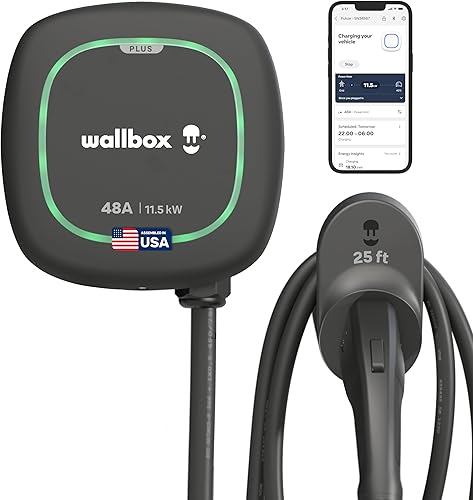
The Pulsar Plus is the smallest Level 2 charger on this list, barely larger than a hardcover book. Despite the compact footprint, it delivers up to 48A / 11.5 kW. The myWallbox app provides scheduling, energy monitoring, and integration with solar panels for eco-conscious charging. Compatible with Amazon Alexa and Google Home for voice control. At ~$550 it’s priced competitively with a feature set that rivals ChargePoint. The Pulsar Plus measures just 7.8” x 7.9” x 3.9” — smaller than a typical home router and dramatically more compact than the boxy ChargePoint and Grizzl-E units. Despite its tiny size, it delivers full 48A / 11.5 kW output. Solar panel integration through the myWallbox app enables eco-smart charging, which automatically increases charger output when excess solar production is available and reduces it when the sun goes down. Static Load Management distributes power evenly if multiple Pulsar Plus units share a circuit. Amazon Alexa and Google Home voice control let you start, stop, and check charging status without opening the app. The NEMA 4 weatherproof rating means it can be installed outdoors without a cover. Multiple color options (black matte, white) let you match your garage aesthetic.
✅ Pros
- Smallest Level 2 charger available
- Solar panel integration for eco-charging
- Alexa and Google Home compatible
- Multiple color options
- Up to 48A / 11.5 kW despite tiny size
✖ Cons
- Cable stiffens in extreme cold
- No NACS connector option
- Solar integration requires additional hardware
- App occasionally loses connection
- ~$550 for J1772-only is premium
Autel AC Lite
Best Value Smart Charger
Autel brings its EV charging expertise to the home market with the AC Lite, offering smart features at a price that undercuts ChargePoint and Emporia. The standout feature is an RFID card reader that pairs with virtually any RFID card. App scheduling, energy monitoring, and load management handle the basics. Delivers up to 40A / 9.6 kW. At ~$440 it’s the most affordable smart charger on this list. The RFID card reader is the Autel’s most unique feature at this price point. It accepts virtually any 13.56 MHz RFID card — including your Tesla key card, office badge, transit pass, or Amazon-purchased RFID cards. This provides simple authentication without needing a phone app, which is convenient for family members or guests who need to use the charger. The app provides scheduled charging based on your utility’s off-peak hours, real-time energy consumption monitoring, and firmware updates. The NEMA 4 weatherproof housing is aluminum alloy construction, giving it a more premium feel than the plastic housings on some budget alternatives. The 25-foot cable is among the longest on this list, providing maximum flexibility for vehicle positioning. At ~$440 it’s $150–$160 less than the top-ranked ChargePoint and Emporia while covering all the smart charging basics.
✅ Pros
- ~$440 is cheapest smart charger on this list
- RFID reader works with any card
- NEMA 4 weatherproof rating
- App scheduling and energy monitoring
- Solid Autel brand reputation
✖ Cons
- 40A max trails 48A competitors
- J1772 only — no NACS option
- App less polished than ChargePoint
- No dynamic load management
- No solar integration
EVIQO Level 2 Charger
Best Newcomer
EVIQO entered the EV charger market with a product that State Of Charge ranked among their 2025 top picks. The charger delivers up to 48A / 11.5 kW with a clean, modern design. Wi-Fi app provides scheduling and energy monitoring. NEMA 14-50 plug-in or hardwired options. At ~$480 it offers 48A smart charging that competes with $600+ alternatives. EVIQO entered the market in 2024 and quickly earned recognition from State Of Charge, one of the most thorough independent EV charger review channels. The charger’s clean, minimalist design avoids the industrial look of some competitors. The Wi-Fi app provides scheduled charging, real-time power monitoring, and charging history — the essentials without the complexity of load management or solar integration. Early Amazon reviews highlight the build quality of the charging connector and the stability of the Wi-Fi connection. The 24-foot cable length matches premium competitors, and the IP66 weatherproof rating means it handles outdoor installation without issues. The plug-in NEMA 14-50 version requires no electrician for installation if you already have the outlet — just mount the bracket, hang the unit, and plug in. EVIQO’s customer support has received positive mentions for fast response times and helpful troubleshooting.
✅ Pros
- 48A / 11.5 kW at ~$480 is great value
- State Of Charge endorsed
- Clean, modern design
- Plug-in or hardwired options
- Responsive customer support reported
✖ Cons
- Newer brand with less track record
- No NACS connector option
- No dynamic load management
- No voice assistant integration
- Limited color options
Lectron V-BOX Pro
Best Portable + Wall
Lectron’s V-BOX Pro bridges the gap between portable and wall-mounted chargers. It mounts to your wall for daily home use but can be unbolted for travel. Delivers up to 48A / 11.5 kW with Wi-Fi app control, scheduling, and energy monitoring. The NEMA 14-50 plug-in design means no hardwiring required. At ~$500 it’s a solid mid-range option with the added flexibility of portability. The V-BOX Pro’s portability is its differentiating feature. While most Level 2 chargers are permanently mounted, the V-BOX Pro’s NEMA 14-50 plug-in design means you can unbolt the wall bracket, coil the cable, and take the entire unit to a different location. This is ideal for EV owners who split time between two homes, need a charger at a vacation property, or plan to move in the near future. The Wi-Fi app provides standard scheduling and monitoring features. A NACS adapter is available for Tesla owners who want to use the J1772 connector without the Tesla-to-J1772 adapter. UL listing provides safety certification, and the unit includes overcurrent, overvoltage, and ground fault protection. The main compromise for portability is a slightly shorter 21-foot cable and a less robust wall-mounting aesthetic compared to permanently installed alternatives.
✅ Pros
- Wall-mount or portable flexibility
- 48A output at mid-range price
- NACS adapter available
- UL-listed safety certification
- No electrician needed (plug-in)
✖ Cons
- 21 ft cable is shorter than competitors
- 2-year warranty trails 3-year standard
- Cable quality trails premium brands
- Portable design less elegant when wall-mounted
- App less refined than ChargePoint
JuiceBox 48
Best Utility Integration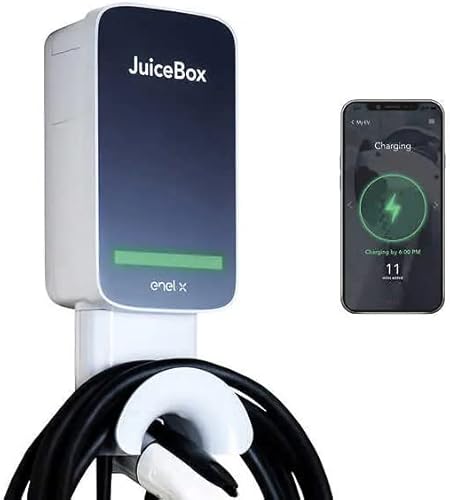
JuiceBox pioneered smart EV charging and their 48A model integrates with more utility company programs than any competitor. The JuiceNet app handles scheduling, energy monitoring, and smart grid integration. Delivers up to 48A / 11.5 kW. ENERGY STAR certified. At ~$600 it matches ChargePoint and Emporia in price but differentiates on utility program compatibility and smart grid features. JuiceBox’s deep utility company integration is the product of years of partnership development with power companies across North America. If your utility offers EV charging rebates, demand-response programs, or time-of-use rate optimization, JuiceBox almost certainly qualifies. The ENERGY STAR certification means it meets EPA energy efficiency standards and may qualify for additional federal or state rebates. The JuiceNet app’s demand-response feature automatically reduces charger output during grid emergencies in exchange for utility credits — effectively paying you to charge your car flexibly. The distinctive LED status ring provides at-a-glance charging status from across the garage, changing color based on charge level and any error conditions. The 25-foot cable and versatile mounting options (plug-in or hardwired) provide installation flexibility. JuiceBox has been in the smart charging space since 2013, making it one of the most established brands with the most refined software platform.
✅ Pros
- Best utility program compatibility
- ENERGY STAR certified
- Smart grid demand-response integration
- 25 ft cable reaches easily
- Mature app with years of refinement
✖ Cons
- Design is functional, not premium
- ~$600 matches competitors without standing out
- No NACS connector option
- LED ring status can be distracting
- No dynamic load management
ShockFlo S1
Best Safety Features
Car Talk highlighted the ShockFlo S1 for its distinctive big red emergency stop button — a feature no other charger includes. Press it to instantly cut power in any emergency. The app handles scheduling, cost tracking, and monitoring. Delivers up to 48A with solid build quality. At ~$500 it’s mid-range pricing. The 17-foot cord is notably short compared to competitors, which may require specific parking orientation. The big red emergency stop button isn’t just decorative — it’s a safety feature that no other consumer EV charger includes. In an electrical emergency, water intrusion, or any situation where you need to immediately cut power to the charging cable, one press disconnects everything instantly. No fumbling with apps, circuit breakers, or pulling the plug. The ShockFlo app provides basic scheduled charging and cost tracking, and Car Talk’s testing found the setup process to be among the fastest they tested — under 10 minutes from unboxing to first charge. The main trade-off is the 17-foot cable, which is 6–8 feet shorter than competitors. In garages where the charger is mounted near the vehicle’s charge port this isn’t an issue, but in longer garages or when the charger is on the opposite wall, you may need to position your vehicle carefully. The RFID card reader adds basic authentication for shared installations.
✅ Pros
- Emergency stop button is a genuine safety advantage
- 48A output at mid-range price
- App scheduling and cost tracking
- Solid build quality
- Quick app setup per Car Talk
✖ Cons
- 17 ft cable is shortest on this list
- Hardwired only — no plug-in option
- 2-year warranty is below average
- No NACS connector option
- Newer brand with limited track record
How We Ranked the Best EV Chargers of 2026
Every ranking on TheShoposaurus starts with extensive research: we evaluate dozens of expert reviews and lab tests, verify manufacturer specifications against official sources, and weigh thousands of verified owner experiences to find the best EV chargers for real drivers. Products are scored on charging speed, connector type, smart features, cable length, and value.
- Best EV chargers — Best Overall EV Charger: ChargePoint Home Flex
- Best EV chargers — Best Smart Charger: Emporia Pro
- Best EV chargers — Best for Tesla Owners: Tesla Universal Wall Connector
- Best EV chargers — Most Durable EV Charger: Grizzl-E Classic
- Best EV chargers — Best Compact Design: Wallbox Pulsar Plus
What is the best EV charger for home in 2026?
The best home EV chargers (Level 2) deliver fast, reliable charging at the amperage your car can accept, a cable long enough to reach your parking spot, and smart features like scheduling and energy tracking. Top picks balance charging speed, build quality, and app control, and many qualify for federal or utility rebates.
How much does it cost to install an EV charger?
Installing a Level 2 home charger typically costs $500–$2,000 including the electrician, depending on how far the charger is from your panel and whether your panel has spare capacity. Simple installs near the panel are cheapest; long runs or a panel upgrade cost more. Federal tax credits and utility rebates can offset a large share.
Level 1 vs Level 2 EV charger — which do you need?
Level 1 charging uses a standard 120V outlet and adds only about 3–5 miles of range per hour, fine for plug-in hybrids or very low mileage. Level 2 uses a 240V circuit and adds roughly 20–40 miles per hour, fully charging most EVs overnight. For a full battery-electric car, a Level 2 charger is the practical choice.
What amperage EV charger do you need?
Most home EV chargers are 32A, 40A, or 48A. A 40A charger on a 50A circuit suits the majority of EVs and adds around 30 miles of range per hour. Go with 48A only if your car accepts that rate and your panel supports it; otherwise 40A is the sweet spot of speed and cost.
Do all electric cars use the same charger?
In North America the industry is standardizing on the NACS (Tesla) connector, while many existing EVs use J1772 for Level 2 charging, and adapters bridge the two. Most home Level 2 chargers work with any EV via the right plug or adapter. Check your car connector type, but a good home charger will serve current and future EVs.