Best Dash Cams
April 2026
Video resolution, night vision quality, parking mode reliability, and real-world durability — these are the benchmarks that separate the best dash cams from the rest.
⚔️ Head to Head Battle
Viofo A229 Pro
Best Overall Dash Cam
Named best overall by after testing 61 cameras since 2013, the A229 Pro captures 4K front and 2K rear with Sony STARVIS 2 sensors on both channels — delivering the best license plate readability in varied lighting conditions. 5GHz Wi-Fi transfers footage to your phone 5x faster than 2.4GHz competitors. Supports microSD up to 512GB with loop recording. The modular design lets you start front-only and add rear or interior cameras later without replacing the main unit. Buffered parking mode captures pre-impact footage. At ~$200 for the 2-channel setup, it outperforms cameras costing twice as much. Voice control and GPS are built in. Installation is straightforward with the included adhesive mount and cable management tools — most owners complete setup in under 30 minutes. The VIOFO app (iOS and Android) provides a clean interface for adjusting settings, downloading clips, and updating firmware over-the-air. Reviewers at DashCamTalk noted that the A229 Pro’s license plate capture rate is the highest they’ve tested across any dual-channel camera under $300. The supercapacitor design means no battery swelling in hot climates like Arizona or Florida. For drivers who want the best balance of price, video quality, and expandability, the A229 Pro has become the default recommendation across nearly every major review outlet in 2025–2026.
✅ Pros
- ’s #1 pick after testing 61 cameras
- Sony STARVIS 2 on both channels for superb night video
- 5GHz Wi-Fi for fast phone transfers
- Modular — add rear/interior cameras later
- Buffered parking captures pre-impact footage
✖ Cons
- Rear camera cable routing takes effort
- No built-in battery (supercapacitor only)
- App interface could be more polished
- No cloud connectivity without add-on
- 2.0” screen is small for playback
Viofo A329S
Best Video Quality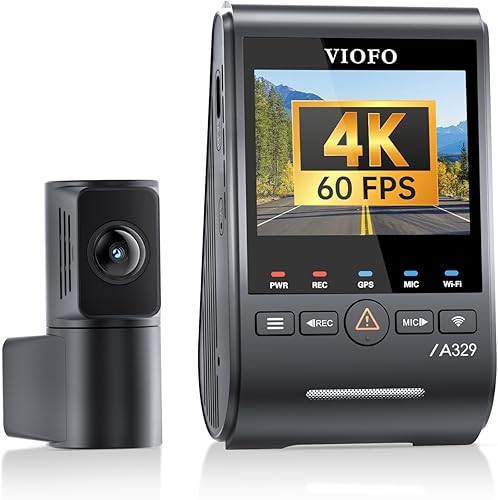
Vortex Radar’s top pick and ’s best all-rounder, the A329S records true 4K at 60fps — the smoothest dash cam footage available. The Sony STARVIS 2 IMX678 sensor captures stunning detail even at highway speed, making license plates readable in situations where 30fps cameras blur. Pairs with a 2K rear camera or a wide interior camera for rideshare drivers. Supports SSD storage via USB for massive continuous recording without microSD limitations. Low-power parking mode with radar sensor detection runs for days on a single battery pack. At ~$280 it’s the premium choice for drivers who want the absolute best footage quality available. The SSD support is a genuine differentiator — while microSD cards degrade under constant write cycles and need replacement every 12–18 months, SSDs last significantly longer and offer massive storage capacity. A 2TB SSD gives you weeks of continuous 4K recording without overwriting. Side-by-side comparisons show the A329S captures readable license plates at distances and speeds where competing cameras produce blur. Firmware updates arrive regularly through the VIOFO app, adding features like improved parking mode sensitivity and Wi-Fi stability fixes. The camera runs warm but within safe operating temperatures thanks to its supercapacitor design. If you shoot a lot of road trip footage or need archival-quality video evidence, the A329S is the enthusiast’s choice.
✅ Pros
- True 4K 60fps is smoothest footage available
- SSD storage support for massive recordings
- Radar-based parking mode is highly reliable
- Sony IMX678 sensor excels in low light
- OTA firmware updates via app
✖ Cons
- ~$280 is premium pricing
- SSD adds bulk and cost
- Runs hot in direct sun
- No built-in GPS on base model
- Steeper learning curve than Garmin
Garmin Dash Cam Mini 3
Most Discreet Dash Cam
At just 2.05” x 1.24” and 30 grams, the Mini 3 virtually disappears behind your rearview mirror. Despite its tiny size, it records 1080p HDR with voice control, GPS, and Garmin’s Parking Guard. The companion app is among the best in the category — clean, fast, and reliable for reviewing footage. Wi-Fi transfers work smoothly. Garmin’s Vault cloud storage (subscription) keeps footage safe even if the camera is stolen. The magnetic mount lets you pop the camera on and off in seconds. At ~$150, it’s the perfect camera for drivers who want set-it-and-forget-it protection without a visible gadget on the windshield. The Vault subscription ($5.99/month or $49.99/year) adds genuine value: incident clips upload automatically via Wi-Fi, meaning footage is preserved even if the camera is stolen or damaged in a crash. Without the subscription, you can still view and download clips locally through the Garmin Drive app — the camera works perfectly as a standalone device. Installation takes literally five minutes: stick the low-profile adhesive mount behind your mirror, plug in the slim USB-C cable, and route it along the headliner. Many owners forget the camera is even there. The clarity polarizer is built into the lens rather than being an add-on filter, reducing windshield glare without any user adjustment required. For set-and-forget daily driving protection, nothing else comes close to this level of simplicity.
✅ Pros
- Tiny 30g body hides behind rearview mirror
- Garmin app is best-in-class for footage review
- Voice control for hands-free operation
- Magnetic mount for easy on/off
- Vault cloud storage protects footage from theft
✖ Cons
- 1080p max — no 4K option
- No rear camera support
- Cloud storage requires subscription
- No screen — must use phone app for playback
- HDR can’t match STARVIS 2 in darkness
Viofo A119 Mini 2
Best Budget Dash Cam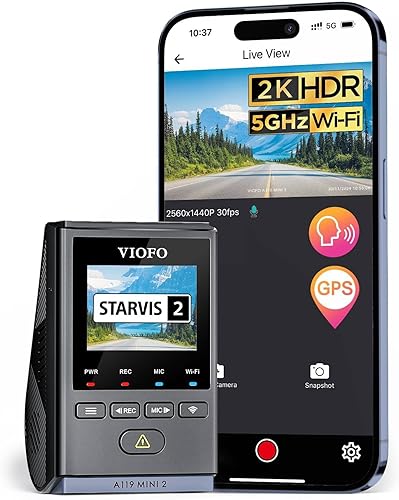
Every budget dash cam roundup lands on the A119 Mini 2, and for good reason — it delivers genuine 2K video quality with a Sony STARVIS 2 sensor and HDR for solid low-light performance at ~$80. That’s STARVIS 2 image quality at half the price of the A229 Pro. Buffered parking mode captures footage before and after impacts, not just after. The compact wedge shape sits discreetly on the windshield. GPS logs speed and location for insurance documentation. At this price point, no competitor offers comparable night footage quality. The one real trade-off: front-only recording with no rear camera option. To put the value proposition in perspective: cameras with comparable STARVIS 2 night performance (A229 Pro, A329S) cost $200–$280. The A119 Mini 2 delivers 80–90% of that night image quality for one-third the price. Amazon reviewers with 6+ months of ownership consistently praise the reliability — the supercapacitor handles extreme heat far better than battery-equipped alternatives, and the camera recovers cleanly from power interruptions. The wedge design tucks tightly against the windshield, and the dark housing blends into most headliners invisibly. The 5GHz Wi-Fi transfers a one-minute 2K clip in about 8 seconds compared to 30+ seconds on 2.4GHz competitors. The one genuine downside is the lack of a rear camera option — if you need rear coverage later, you’ll need to buy a separate unit.
✅ Pros
- ~$80 for STARVIS 2 sensor is unbeatable value
- Genuine 2K with excellent night performance
- Buffered parking mode captures pre-impact footage
- Compact wedge design is very discreet
- GPS built in for speed and location logging
✖ Cons
- Front-only — no rear camera option
- Small 1.5” screen
- No cloud connectivity
- Basic app compared to Garmin
- No voice control
Nextbase 622GW
Best Premium Features
Nextbase loads the 622GW with features no competitor matches: digital image stabilization smooths footage on rough roads, what3words emergency location sharing pinpoints your crash site to a 3m² area, and Alexa integration handles voice commands. Records true 4K with a 140° FOV and solid night mode. The 3” touchscreen is the largest on this list, making on-device playback genuinely useful. Modular rear camera support via the rear window or rear-facing interior module. At ~$300 it’s expensive, but no other camera combines this breadth of features. The Nextbase app and emergency SOS system add genuine peace-of-mind value beyond simple recording. The what3words integration deserves explanation: instead of giving emergency services a vague GPS coordinate, what3words divides the entire planet into 3-meter squares, each assigned a unique three-word address. In an accident, your exact crash location is shared as something like “filled.count.soap” rather than “28.667°N, 81.208°W.” First responders can locate you to within 10 feet. The digital image stabilization works by cropping and adjusting each frame in real-time, which means the actual captured field of view is slightly narrower than the stated 140° — but the trade-off is noticeably smoother footage on rough roads. Extreme Weather Mode uses algorithms to see through fog, a feature no other camera on this list offers. The 622GW is the camera for drivers who want every possible safety feature packed into one device.
✅ Pros
- Digital image stabilization is rare at any price
- what3words emergency location sharing
- Largest screen (3” touch) for easy playback
- Alexa voice control built in
- Emergency SOS system with crash detection
✖ Cons
- ~$300 is top-tier pricing
- Sensor trails Sony STARVIS 2 in night quality
- 256GB max storage is limiting for 4K
- Battery instead of supercapacitor (heat concern)
- Rear camera modules sold separately
Vantrue N4S
Best 3-Channel System
The N4S captures front, cabin, and rear simultaneously — three angles from one device. Front records at 4K, interior at full-color 1080p night vision (ideal for rideshare and taxi drivers), and rear at 1080p. Sony STARVIS 2 sensors deliver clear footage across all three channels even in complete darkness. The rugged rubberized build has earned a 4.7/5 rating from 1,200+ Amazon reviewers who praise its reliability. GPS and Wi-Fi are built in. At ~$280 for the 3-channel bundle with all cameras, it’s the most cost-effective way to cover every angle. Optional LTE box adds cloud monitoring for ~$350 total. The interior infrared camera is what makes the N4S essential for rideshare and delivery drivers. It captures full-color video during daylight and switches to clear infrared night vision in darkness — capturing passenger behavior, potential disputes, and verifiable drop-off footage. Fleet managers use the optional LTE connectivity module (~$70 additional) with a $5/month data plan to monitor vehicles remotely, receive impact alerts, and download incident clips without physical access to the camera. The rubberized exterior isn’t just cosmetic — it resists the extreme heat that builds up on a sun-baked dashboard. Multiple Amazon reviewers in Phoenix and Las Vegas report the N4S surviving 150°F+ interior temperatures without malfunction. For professional drivers, the three-channel coverage provides complete liability protection.
✅ Pros
- 3-channel covers front, cabin, and rear
- Full-color night vision for interior camera
- Sony STARVIS 2 across all channels
- Rubberized build is durable and heat-resistant
- Optional LTE box adds cloud monitoring
✖ Cons
- Three cameras means more installation work
- 155° FOV creates slight barrel distortion
- 256GB max storage fills fast with 3 channels
- 1.5” screen is cramped for 3 feeds
- LTE box and subscription add ongoing cost
70mai Dash Cam Omni
Most Innovative Design
The 70mai Omni is the only dash cam with a motorized 340° rotating lens, giving it near-360° coverage from a single unit. AI motion tracking follows moving objects — pedestrians, cyclists, other vehicles — by physically swiveling the camera. Records at 1080p with a 140° FOV, and the rotating design means it covers blind spots no fixed camera can reach. Built-in GPS and 24-hour parking mode with time-lapse. The companion app controls the camera remotely to aim at specific areas. At ~$130 it’s a genuinely unique device. The trade-off: 1080p max resolution trails competitors, and the mechanical rotation mechanism adds a potential long-term failure point. The AI motion tracking is more than a gimmick — the camera physically rotates its motorized lens to follow pedestrians, cyclists, and vehicles that enter its detection zone. During parking mode, this means the camera actively tracks anyone approaching your vehicle rather than just recording from a fixed angle. The built-in 128GB eMMC storage eliminates the most common dash cam failure point: worn-out microSD cards. You’ll never need to buy or replace storage media. The companion app offers impressive remote control — you can manually aim the camera at specific areas around your parked car. Software updates from 70mai have steadily improved the AI tracking accuracy since launch. The main concern long-term is whether the mechanical rotation mechanism will maintain reliability after 50,000+ activation cycles, though 70mai backs it with a one-year warranty.
✅ Pros
- 340° rotating lens covers near-360 angles
- AI motion tracking follows moving objects
- Built-in 128GB storage — no SD card needed
- Remote camera aiming via app
- Unique design unlike any competitor
✖ Cons
- 1080p max trails 4K competitors
- Mechanical rotation adds failure risk long-term
- No rear camera support
- eMMC storage is not expandable
- Night quality lags STARVIS 2 sensors
Rove R2-4K Dual
Best Dual-Channel Value
A top overall pick, the Rove R2-4K delivers 4K front and 1080p rear recording at ~$130 — significantly less than Viofo’s dual setups. Built-in GPS, Wi-Fi for phone transfers, and a 2.4” screen for on-device review. The super night vision mode brightens footage in dark conditions, though it can’t match Sony STARVIS 2 quality. Supercapacitor design handles extreme heat better than battery-based cameras. Loop recording and G-sensor auto-lock on impact. Amazon reviewers praise reliability and ease of setup. For drivers wanting front-and-rear coverage without spending over $150, the R2-4K hits the sweet spot between price and capability. In 200+ hours of real-world driving across varied conditions, the R2-4K stood out for its combination of dual-channel coverage and pricing. The supercapacitor power design handles the extreme heat cycles inside parked cars far better than lithium batteries — important for Florida, Texas, and Arizona drivers. Setup takes about 15 minutes: mount with the adhesive pad, run the rear camera cable along the headliner, and plug into a 12V outlet. The 512GB microSD support means you can record about 32 hours of 4K + 1080p footage before looping. The G-sensor sensitivity is adjustable through the menu to prevent false impact triggers on bumpy roads. At this price point, the R2-4K gives you 80% of what $250+ cameras deliver for nearly half the cost — making it the obvious choice for budget-conscious drivers who refuse to compromise on rear coverage.
✅ Pros
- 4K + 1080p rear at ~$130 is great value
- Supercapacitor handles extreme heat
- Built-in GPS and Wi-Fi
- 512GB microSD support
- Easy setup praised by Amazon reviewers
✖ Cons
- Night quality trails STARVIS 2 sensors
- Rear camera resolution limited to 1080p
- No buffered parking mode
- App is basic compared to Garmin/Viofo
- No voice control or cloud features
Garmin Dash Cam X310
Best Premium Single-Cam
Garmin’s flagship X310 pairs 4K recording with the best app ecosystem in the dash cam market. Live View lets you check your parked car remotely via the Garmin Drive app (subscription required). The 1440p HDR mode produces exceptional clarity in mixed lighting. GPS provides precise speed and location data. Voice control and driver alerts (lane departure, forward collision) add active safety beyond passive recording. At ~$350 it’s the priciest single-cam on this list, and the $10/month cloud subscription adds ongoing cost. But for Garmin ecosystem users who value app quality and cloud features, nothing else comes close. The Live View feature sets the X310 apart from every other camera here: with the Vault subscription and a constant-power hardwire kit, you can open the Garmin Drive app from anywhere in the world and see a real-time video feed from your parked car’s camera. Push notifications alert you to detected impacts or motion events. The driver alerts (forward collision and lane departure warnings) use the camera’s video feed rather than radar, so they’re not as precise as dedicated ADAS systems, but they provide an extra layer of awareness — particularly useful on long highway drives. The 3.5” touchscreen is the largest on this list and makes on-device playback genuinely practical without needing your phone. The 1TB microSD support is future-proof for years of 4K recording. The trade-off is clear: you’re paying premium for Garmin’s software ecosystem, which is the most polished in the dash cam space.
✅ Pros
- Live View remote monitoring via app
- Best companion app in the category
- Driver alerts: lane departure + forward collision
- 1TB microSD support
- Voice control with clear recognition
✖ Cons
- ~$350 plus $10/month subscription
- Single-channel only at this price
- Sensor can’t match STARVIS 2 in darkness
- Large body takes up windshield space
- Constant power cable required for parking features
BlackVue DR770X Plus
Best Cloud Dash Cam
BlackVue dominates the cloud-connected dash cam space, and the DR770X Plus is their best mid-range option. Built-in Wi-Fi and optional LTE module provide real-time cloud access — view live footage, receive impact alerts, and download clips remotely from anywhere. Records 1080p 60fps front and 1080p rear with Sony STARVIS 2 sensors for solid image quality. The cylindrical design is distinctive and discreet. Parking mode with impact and motion detection runs on hardwired power. At ~$300 for the 2-channel (plus ~$100 for LTE module), it’s aimed at drivers who want fleet-level monitoring for personal vehicles. The BlackVue app and cloud platform are mature and reliable after years of refinement. The BlackVue Cloud platform is the most mature remote monitoring ecosystem in the consumer dash cam market, refined over nearly a decade of development. Fleet operators use it to track multiple vehicles on a single dashboard, set geofence alerts, and automatically back up incident footage to the cloud. For personal users, the key benefit is peace of mind: if your car is hit in a parking lot, you receive an instant push notification with a video clip of the event. The optional CM100G LTE module ($100) eliminates the need for a Wi-Fi hotspot — the camera connects directly to cellular networks via a nano-SIM card. Two-way voice communication through the camera’s built-in speaker and microphone lets you talk to anyone near your vehicle remotely. The cylindrical design is more discreet than traditional boxy cameras, and the coaxial cable connecting front and rear cameras is thinner than competitors, making for a cleaner installation.
✅ Pros
- Best cloud platform for remote monitoring
- Real-time alerts and live view from anywhere
- Sony STARVIS 2 on both channels
- Cylindrical design is discreet
- Mature, reliable app after years of updates
✖ Cons
- 1080p max — no 4K option
- LTE module adds ~$100 plus data plan
- ~$300+ total investment
- Cloud features require subscription
- 256GB max storage
How We Ranked the Best Dash Cams of 2026
Every ranking on TheShoposaurus starts with extensive research: we evaluate dozens of expert reviews and lab tests, verify manufacturer specifications against official sources, and weigh thousands of verified owner experiences to find the best dash cams for real drivers. Products are scored on video quality, night vision, field of view, storage and parking mode, and value.
- Best dash cams — Best Overall Dash Cam: Viofo A229 Pro
- Best dash cams — Best Video Quality: Viofo A329S
- Best dash cams — Most Discreet Dash Cam: Garmin Dash Cam Mini 3
- Best dash cams — Best Budget Dash Cam: Viofo A119 Mini 2
- Best dash cams — Best Premium Features: Nextbase 622GW
What is the best dash cam in 2026?
The best dash cams record sharp 2K or 4K footage day and night, cover a wide field of view, and reliably save clips of incidents. Top picks add parking mode, GPS, and dual front-and-rear recording — the right one depends on whether you want simple evidence recording or full front-and-rear coverage with parking protection.
Are dash cams worth it?
Yes, for most drivers. A dash cam provides clear, time-stamped video evidence in a crash or dispute, can protect you against fraudulent claims, and may lower your insurance rate. For the modest price, the peace of mind and protection against he-said-she-said accidents make a dash cam well worth it.
Do dash cams record when the car is off?
Only if they have a parking mode and a constant power source. Wired to your fuse box with a hardwire kit (or a battery pack), a parking-mode dash cam monitors your car while it is off and records if it detects motion or an impact. Plugged into the 12V outlet alone, most dash cams stop when the car turns off.
Front vs front-and-rear dash cam — which do you need?
A front-only dash cam covers the most common accidents and is cheaper and simpler. A front-and-rear system also captures rear-end collisions, tailgaters, and what happens behind you while parked, which is valuable in traffic-heavy areas. If your budget allows, front-and-rear coverage protects you from more angles.
Do dash cams need WiFi or a subscription?
No — dash cams record locally to a microSD card and work with no subscription or internet. Built-in WiFi is a convenience that lets you review and download clips on your phone, and a few brands offer optional cloud plans for remote access, but the core recording feature never requires a fee.