Best Nothing Phones
Ranked 2026
Nothing built a brand around transparent design, Glyph lights, and clean software. Here’s every current model scored on performance, value, build quality, and whether the style actually delivers substance.
⚔️ Head to Head Battle
Nothing Phone (3)
Best Nothing Phone Overall
Nothing’s first true flagship and a genuine competitor to phones costing hundreds more. The Phone (3) runs the Snapdragon 8s Gen 4 — a capable near-flagship chip that handles demanding games, 4K video editing, and heavy multitasking without breaking a sweat. The quad 50MP camera system is a standout: main, periscope telephoto, ultrawide, and front-facing sensors all share the same resolution, producing consistent quality across every lens. The 6.77-inch AMOLED display delivers 120Hz adaptive refresh, 1.07 billion colors, and HDR10+ support that makes content look genuinely impressive. IP68 water resistance, 5,150mAh battery, 45W wired charging, and wireless charging round out a complete spec sheet. NothingOS remains one of the cleanest Android skins available — fast, bloatware-free, and thoughtfully designed. The Glyph Interface on the transparent back is polarizing but undeniably unique. The main weakness: only 3 years of OS updates, which trails Samsung’s 7 and Google’s 7 by a wide margin.
✓ Pros
- Quad 50MP camera system delivers consistent quality across all lenses
- NothingOS is one of the cleanest, fastest Android skins available
- IP68 + wireless charging + 45W wired at $639 is strong value
- Transparent back with Glyph Interface is genuinely unique
✗ Cons
- Only 3 years of OS updates — less than half of Samsung or Google
- Glyph lights are fun but functionally limited for daily use
- No US carrier support — GSM only (AT&T/T-Mobile)
- Snapdragon 8s Gen 4 is near-flagship, not true flagship tier
Nothing Phone (4a) Pro
Best Mid-Range Nothing
Nothing’s newest release and its lead phone for 2026 — there won’t be a Phone (4) flagship this year. The 4a Pro marks a bold design departure: gone is the fully transparent back, replaced by a premium aluminum unibody at just 7.9mm thin with a semi-transparent camera module window. The 6.83-inch 144Hz AMOLED display peaks at a record-breaking 5,000 nits, making it one of the brightest phone screens ever made and effortlessly readable in direct sunlight. The triple camera system adds a 50MP periscope telephoto with 3.5x optical zoom and up to 140x ultra zoom — rare at any price, let alone $499. The Snapdragon 7 Gen 4 handles daily tasks and moderate gaming smoothly, though it’s noticeably behind the Phone (3)’s 8s Gen 4 in raw power. The all-new Glyph Matrix features 137 individually controllable mini-LEDs that function as a secondary display. NothingOS 4.1 on Android 16 is clean and intuitive. The trade-offs: IP65 (not IP68), only 3 years of OS updates, and 50W charging is good but not class-leading.
✓ Pros
- 5,000-nit 144Hz AMOLED is one of the brightest phone displays ever
- 50MP periscope telephoto with 3.5x optical zoom is rare at $499
- Premium aluminum unibody design at just 7.9mm thin
- Glyph Matrix with 137 mini-LEDs acts as a functional secondary display
✗ Cons
- Only IP65 water resistance — no submersion protection
- 3 years of OS updates trails Pixel 10a’s 7-year commitment
- Snapdragon 7 Gen 4 is mid-range — won’t match flagship performance
- 128GB base storage feels insufficient in 2026
Nothing Phone (3a)
Best Budget Nothing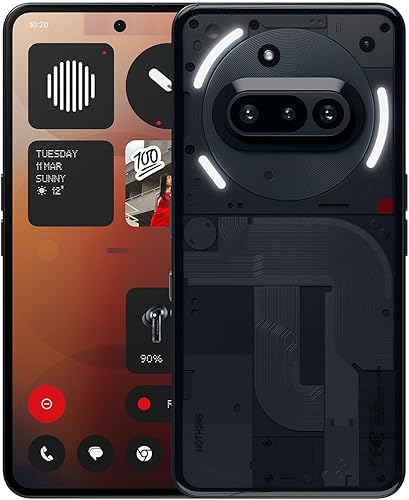
The phone that put Nothing on the map as a serious mid-range contender. The Phone (3a) punches above its weight with a feature rarely found under $400: a 50MP periscope telephoto with 3x optical zoom. Combined with a 50MP main sensor and 8MP ultrawide, the camera system offers versatility that competitors like the Pixel 9a and Galaxy A56 simply can’t match at this price. The 6.77-inch 120Hz AMOLED display peaks at 3,000 nits with HDR10+ support, delivering vibrant visuals that rival phones twice the price. The Snapdragon 7s Gen 3 strikes a good balance between performance and efficiency, and the 5,000mAh battery with 50W fast charging comfortably lasts a full day with a quick 20-minute top-up when needed. NothingOS on Android 15 keeps the experience clean and snappy. The Glyph Interface adds personality, though it’s less elaborate than the Phone (3)’s version. The main compromises are IP64 water resistance (splash-proof only, not submersible) and the same 3-year update window that limits long-term value.
✓ Pros
- 50MP periscope telephoto with 3x optical zoom is exceptional at ~$350
- 120Hz AMOLED with 3,000-nit brightness rivals phones twice the price
- 50W fast charging delivers a day’s power in ~20 minutes
- Clean NothingOS with Glyph Interface adds genuine personality
✗ Cons
- Only IP64 — splash-proof but not submersible like IP68 competitors
- 3 years of OS updates is short vs Pixel 9a’s 7 years
- No wireless charging at this price
- Ultrawide camera is only 8MP — noticeably weaker than main sensor
Nothing Phone (2)
Best Value (Discounted)
The phone that established Nothing’s design language and proved the brand could deliver substance alongside style. Now available at significant discounts from its original $599 launch price, the Phone (2) remains a compelling option for buyers who want the iconic transparent Glyph Interface at a lower entry point. The Snapdragon 8+ Gen 1 is still a capable chipset in 2026 for everyday tasks, social media, and casual gaming, though it shows its age with demanding workloads. The 6.7-inch LTPO AMOLED display with 120Hz adaptive refresh and 1600-nit peak brightness looks great, and the dual 50MP camera system (main + ultrawide) produces solid photos with natural color science and effective night mode. Battery life from the 4,700mAh cell gets through a full day, and 45W charging tops it up quickly. The biggest concerns are the aging IP54 water resistance (rain-proof at best) and diminishing software support — with only 3 OS updates promised, the Phone (2) is nearing the end of its update window.
✓ Pros
- Iconic transparent Glyph Interface design at a discounted price
- Snapdragon 8+ Gen 1 still handles everyday tasks well
- LTPO AMOLED with 120Hz adaptive refresh looks great
- Dual 50MP cameras produce solid photos with natural colors
✗ Cons
- IP54 is rain-proof only — far behind IP68 competitors
- Software updates nearing end of life in 2026
- 4,700mAh battery is smaller than newer Nothing phones
- No telephoto lens limits camera versatility
How We Ranked the Best Nothing Phones of 2026
Every ranking on TheShoposaurus starts with extensive research: we evaluate dozens of expert reviews and lab tests, verify manufacturer specifications against official sources, and weigh thousands of verified owner experiences to find the best Nothing phones for real buyers. Products are scored on performance, display, camera, battery life, software updates, and value.
- Best Nothing phones — Best Nothing Phone Overall: Nothing Phone (3)
- Best Nothing phones — Best Mid-Range Nothing: Nothing Phone (4a) Pro
- Best Nothing phones — Best Budget Nothing: Nothing Phone (3a)
- Best Nothing phones — Best Value (Discounted): Nothing Phone (2)
What is the best Nothing phone in 2026?
The best Nothing phone for most people is the flagship Nothing Phone (3), which pairs the brand transparent, Glyph-lit design with strong performance and clean software. The a-series models offer most of the experience for less, so the right Nothing phone depends on whether you want the flagship or the best value.
Are Nothing phones good?
Yes — Nothing phones stand out for their unique transparent design, the Glyph LED notification system, and unusually clean, bloat-free software. Performance and cameras are solid for the price, and update support has improved. They are a genuinely good alternative for anyone who wants something different from Samsung and Apple without sacrificing usability.
Which Nothing phone should you buy?
Buy the flagship Nothing Phone (3) for the best performance, cameras, and full Glyph experience. Choose an a-series model like the Phone (4a) Pro or (3a) for most of the design and software at a lower price. The a-series delivers the best value, while the flagship is for those who want it all.
Do Nothing phones get software updates?
Nothing flagship phones now come with multiple years of OS and security updates — typically around three OS versions and longer security support — which is competitive though not class-leading. Check the specific model promised update window, since it varies between flagship and a-series phones.
Is a Nothing phone worth it vs Samsung or Pixel?
A Nothing phone is worth it if you value distinctive design and clean software and want to stand out. Samsung and Google Pixel still lead on camera processing and the longest update commitments, so if those are your priorities they are safer picks. For personality plus solid performance at a fair price, Nothing is a compelling choice.