📷 COMPACT CAMERA HEAD-TO-HEAD
Ricoh GR IIIx vs Fujifilm X100VI — Pocket Legend vs Retro Powerhouse
Two cult-favorite fixed-lens APS-C compacts with radically different philosophies. One fits in your jeans pocket; the other delivers a 40MP hybrid viewfinder experience. We compare everything from image quality and portability to street photography stealth.
⚡ Quick Verdict
The Fujifilm X100VI wins on capability with its 40MP BSI sensor, hybrid OVF/EVF, 6.2K video, 5-axis IBIS, weather sealing, and legendary film simulations. It’s the more complete camera by virtually every spec. But the Ricoh GR IIIx wins on philosophy — at half the weight, truly pocketable size, $600 less, and stealth that makes it invisible on the street.

VS
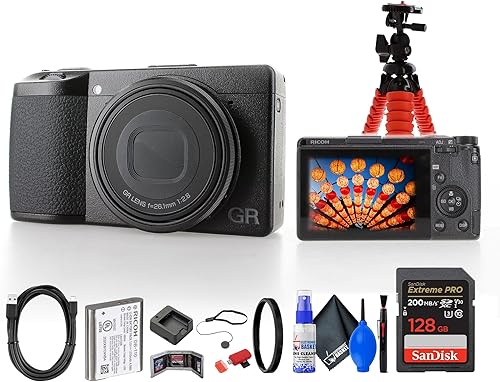
| Specification | X100VI | GR IIIx |
|---|---|---|
| Sensor | 40.2MP APS-C X-Trans BSI | 24.2MP APS-C CMOS (Bayer) |
| Lens | 23mm f/2 (35mm equiv) | 26.1mm f/2.8 (40mm equiv) |
| Viewfinder | Hybrid OVF/EVF (3.69M dots) | None |
| Video | 6.2K 30p / 4K 60p | 1080p 60fps (limited quality) |
| IBIS | 5-axis, up to 6 stops | 3-axis Shake Reduction |
| Screen | 3.0″ tilting, 1.62M dots | 3.0″ fixed, 1.04M dots |
| AF System | 425-point hybrid (phase+contrast) | Hybrid AF (slower in low light) |
| Burst Rate | 11fps mech / 20fps e-shutter | 4fps |
| Battery Life | ~450 shots (NP-W126S) | ~200 shots (DB-110) |
| Weather Sealed | Yes (dust/splash) | No (dust ingestion risk) |
| Film Simulations | 20 modes (incl. REALA ACE) | Image Control profiles |
| Weight | 521g | 262g |
| Dimensions | 128 × 75 × 55mm | 109 × 62 × 35mm |
| Pocketable? | Large coat pocket only | Yes — jeans pocket |
| ISO Range | 125–12,800 (ext. 64–51,200) | 100–102,400 |
| Built-in ND | No | Yes (2-stop) |
| Price | ~$1,599 | ~$999 |
Image Quality & ResolutionWinner: X100VI
The X100VI’s 40.2MP X-Trans CMOS 5 HR sensor is a technical marvel — the same chip found in Fujifilm’s flagship X-T5 and X-H2, delivering 67% more resolution than the GR IIIx’s 24.2MP Bayer sensor. That’s not just a spec-sheet number: the difference is visible in real-world prints above 16 inches and when cropping aggressively for social media or different aspect ratios. The X-Trans pixel array eliminates moiré without requiring an optical low-pass filter, preserving every bit of detail the lens can resolve. The Fujinon 23mm f/2 lens is optically excellent — sharp across the frame even wide open — and its full stop of additional light gathering over the GR IIIx’s f/2.8 means visibly more subject separation with smoother background blur, plus a genuine low-light advantage at identical ISO settings. Fujifilm’s 20 film simulations are the secret weapon that seals this category: modes like Classic Negative, Nostalgic Neg, ACROS, and the new REALA ACE produce distinctive, emotionally resonant JPEGs with character that many photographers never feel the need to edit. The Ricoh’s Image Control profiles offer customization but lack the depth, variety, and aesthetic quality of Fuji’s decades-refined film emulations. That said, the GR IIIx’s 24.2MP sensor with its tack-sharp 40mm-equivalent f/2.8 GR lens is no slouch — it produces excellent images with wonderful color and contrast that are more than sufficient for web publication, social media, and standard-size prints. Its built-in 2-stop ND filter is a practical advantage the X100VI lacks, enabling wide-aperture shooting in bright sunlight without needing an external filter adapter.
X100VI: 40.2MP X-Trans BSI sensor with f/2 lens delivers stunning detail. 20 film simulations produce JPEGs that many photographers never bother to edit.
GR IIIx: 24MP sensor with tack-sharp 40mm f/2.8 lens produces excellent images. Built-in 2-stop ND filter enables wide-aperture shooting in bright light.
Portability & Street StealthWinner: GR IIIx
This is the GR IIIx’s raison d’être, and it wins so decisively that this single category justifies its existence alongside technically superior cameras. At 262 grams and just 35 millimeters thick with the lens retracted, the GR IIIx genuinely, honestly, no-hyperbole fits in a standard pair of jeans — front pocket, back pocket, doesn’t matter. The retractable lens collapses flush with the body when powered off, creating a smooth, flat profile that doesn’t snag or bulge. You can forget it’s there until you need it. The X100VI at 521g is nearly double the weight and 20mm thicker, with a fixed protruding lens barrel that makes true pocket carry impossible in anything smaller than a large winter coat. It’s compact for a camera, but it’s not pocketable — and that distinction matters enormously for photographers who want a camera with them 100% of the time. On the street, the difference in conspicuousness is dramatic. The GR IIIx looks like an old tourist point-and-shoot from the 2000s. Nobody gives it a second glance. This invisibility is a superpower for candid street photography — subjects don’t stiffen, don’t pose, don’t look away. You capture life as it actually happens. The X100VI, especially in silver, looks like a vintage Leica rangefinder. It’s beautiful, but it broadcasts “I’m a photographer” to everyone within eyeshot. The Ricoh’s legendary Snap Focus mode compounds the stealth advantage: preset a focus distance (say, 2.5 meters at f/8), and you can shoot from the hip — camera at waist level, no viewfinder, no LCD, no raising the camera to your face — and nail sharp images instantly. No other camera enables this workflow as seamlessly.
X100VI: At 521g with a protruding lens, it’s a compact camera in name but not in pocket. The retro design draws attention on the street.
GR IIIx: At 262g and 35mm thin, it disappears into any pocket. Snap Focus mode lets you shoot from the hip without even raising the camera.
Viewfinder & Shooting ExperienceWinner: X100VI
The X100VI’s hybrid optical/electronic viewfinder is genuinely unique in the camera world — no other current production camera offers anything like it. Flip a lever on the front of the camera and you switch between a bright optical rangefinder view (showing the real world with framelines overlaid, just like a classic Leica M) and a high-resolution 3.69-million-dot electronic viewfinder that shows exactly what the sensor sees, including exposure preview, histogram, and focus peaking. The optical mode is faster and more natural for street shooting — you see outside the framelines, anticipating subjects entering the composition. The electronic mode is essential for precise exposure evaluation and manual focus work. Combined with dedicated analog dials for aperture (on the lens barrel), shutter speed (on top plate), and exposure compensation, the X100VI delivers a shooting experience that feels like using a classic rangefinder from photography’s golden age — while having every modern technological advantage hidden beneath the surface. It’s tactile, deliberate, and deeply satisfying in a way that menu-driven cameras simply cannot replicate. The GR IIIx takes the opposite approach: no viewfinder at all. You compose entirely on the fixed 3.0-inch, 1.04-million-dot rear LCD. In controlled environments this works fine, but bright outdoor sunlight washes out the screen significantly, making precise composition difficult. Ricoh compensates with zone focusing and Snap Focus — techniques that bypass the need to see the screen at all — but for photographers who value eye-level composition for portraits, landscapes, or deliberate framing, the absence of any viewfinder is a genuine limitation that defines the GR IIIx as a specific tool rather than a general-purpose camera.
X100VI: Hybrid OVF/EVF is unmatched in compact cameras. Analog dials deliver tactile joy. The tilting touchscreen adds low-angle versatility.
GR IIIx: No viewfinder — LCD-only composition washes out in sunlight. Snap Focus is brilliant for hip-shooting street work.
Video CapabilitiesWinner: X100VI
The video gap between these cameras is the widest of any category in this comparison — it’s not a contest. The X100VI records 6.2K at 30fps for extraordinary detail, oversampled 4K at 60fps for smooth motion, and 1080p at up to 240fps for dramatic slow-motion. F-Log2 provides over 13 stops of dynamic range for professional color grading, and the 5-axis IBIS keeps handheld footage steady without requiring a gimbal. Continuous phase-detect autofocus works during video recording, smoothly tracking subjects as they move through the frame. You can genuinely use the X100VI as a solo video production tool for vlogs, short films, and social content. The GR IIIx’s video capability is, frankly, vestigial. It records 1080p at up to 60fps with no continuous autofocus during video — meaning focus locks at the start of recording and stays there, regardless of subject movement. Image quality is soft and grainy by modern standards, stabilization is limited to the 3-axis shake reduction system that’s designed for stills, and there’s no log profile for grading. The GR IIIx’s video is, frankly, terrible and unusable — and that assessment is fair. If you even occasionally shoot video — family clips, travel memories, social media stories — the X100VI is the only option. The GR IIIx is a pure stills camera that happens to have a record button.
X100VI: 6.2K 30p and 4K 60p with F-Log2, IBIS-stabilized, with continuous phase-detect AF. A genuine hybrid camera.
GR IIIx: 1080p 60fps with no continuous AF during recording. Video quality is poor by any 2026 standard. This is a stills-only camera.
Value & AvailabilityWinner: GR IIIx
The GR IIIx costs approximately $999 while the X100VI commands roughly $1,599 — a $600 gap that represents a fundamentally different price tier. That $600 savings isn’t trivial: it’s enough to buy two premium fast-charge spare batteries, a quality wrist strap, a 128GB high-speed SD card, and still have cash left over. Or you could invest in the GR III (28mm equivalent) as a companion, giving you two truly pocketable cameras covering both the classic street photography focal length and a standard normal perspective — all for roughly the same total investment as a single X100VI. The X100VI’s pricing is further complicated by chronic supply shortages that have plagued the X100 series since its February 2024 launch. Fujifilm has struggled to meet demand, and authorized retailers frequently show “out of stock” or “backorder” status. Third-party sellers and resellers routinely charge $200–400 above the $1,599 MSRP, pushing the real-world acquisition cost toward $1,800–2,000. The GR IIIx, by contrast, is generally available at or near its retail price from major camera retailers. For photographers on a budget, the GR IIIx represents extraordinary value — a genuinely pocketable APS-C camera with excellent image quality for a thousand dollars. The X100VI represents the premium choice: more capability in every measurable dimension, but at a significant and sometimes inflated cost.
X100VI: At $1,599, it’s the most expensive APS-C compact. Supply shortages push prices even higher.
GR IIIx: At ~$999, it’s $600 less. Some photographers buy both the GR III and GR IIIx for the price of one Fuji.
X100VI — Pros & Cons
- ✓ 40.2MP X-Trans BSI sensor — 67% more resolution
- ✓ Hybrid OVF/EVF viewfinder — unique in compact cameras
- ✓ f/2 lens gathers a full stop more light
- ✓ 6.2K 30p / 4K 60p video with F-Log2 and continuous AF
- ✓ 5-axis IBIS with up to 6 stops
- ✓ 20 film simulations including REALA ACE
- ✓ Weather sealed with built-in flash
- ✖ 521g and 55mm thick — not truly pocketable
- ✖ $1,599 price tag is steep
- ✖ Chronic supply shortages push prices above MSRP
- ✖ No built-in ND filter
- ✖ Silver model attracts attention on the street
GR IIIx — Pros & Cons
- ✓ Genuinely pocketable at 262g and 35mm thin
- ✓ Invisible on the street — nobody recognizes it
- ✓ Snap Focus enables instant hip-shooting
- ✓ Built-in 2-stop ND filter
- ✓ ~$999 — $600 less than X100VI
- ✓ 2GB internal storage as backup
- ✓ ISO range extends to 102,400
- ✖ No viewfinder of any kind — LCD only
- ✖ 24MP sensor is a generation behind
- ✖ Video is essentially unusable
- ✖ No weather sealing — lens can ingest dust
- ✖ Only 200 shots per battery charge
- ✖ Slower AF in low light
Buy the X100VI if you…
- Want the best image quality from a fixed-lens compact
- Value a viewfinder for precise composition
- Shoot video as well as stills
- Love Fujifilm’s film simulations
- Need weather sealing for outdoor photography
Buy the GR IIIx if you…
- Need a camera that fits in your jeans pocket
- Shoot street photography where stealth matters most
- Want to save $600 and still get excellent APS-C quality
- Prefer a 40mm field of view over 35mm
- Want a camera you’ll carry every single day
Final Verdict
The X100VI is objectively the better camera — it wins on resolution, lens speed, viewfinder, video, stabilization, AF, and build quality. But the GR IIIx might be the better purchase, because the camera you have with you is the camera that matters. At half the weight and truly pocketable, the GR IIIx goes everywhere. If you can only own one camera, buy the X100VI. If you want a camera always in your pocket, the GR IIIx is the only real answer.
Frequently Asked Questions
Is the Ricoh GR IIIx really pocketable?
Yes, genuinely. At 109 × 62 × 35mm and 262g, it fits in standard jeans pockets. The retractable lens makes the camera completely flat when off.
Which focal length is better — 35mm or 40mm?
The X100VI’s 35mm is slightly wider and more versatile. The GR IIIx’s 40mm is closer to human vision. If you prefer 28mm, the Ricoh GR III (non-x) offers that.
Can the X100VI fit in a pocket?
Only in a large jacket or coat pocket. Its protruding lens makes it 55mm thick and at 521g it’s noticeably heavy.
Is the GR IIIx good for video?
No. 1080p only with no continuous autofocus. If you need video, the X100VI with 6.2K/4K is the clear choice.
Why is the X100VI so hard to buy?
Fujifilm has struggled with supply since launch. Demand consistently exceeds production, pushing real-world prices above $1,599 MSRP.
Can I buy both GR III and GR IIIx for less than one X100VI?
Yes. Together they cost roughly $2,000, giving you two pocketable focal lengths (28mm and 40mm) for the price of one Fuji.
Affiliate Disclosure: This comparison contains affiliate links. The Shoposaurus may earn a commission at no additional cost to you. See our full disclosure and editorial standards.